Humanoid Robots in Industrial Warehouses: What Gulf Manufacturers Need to Know

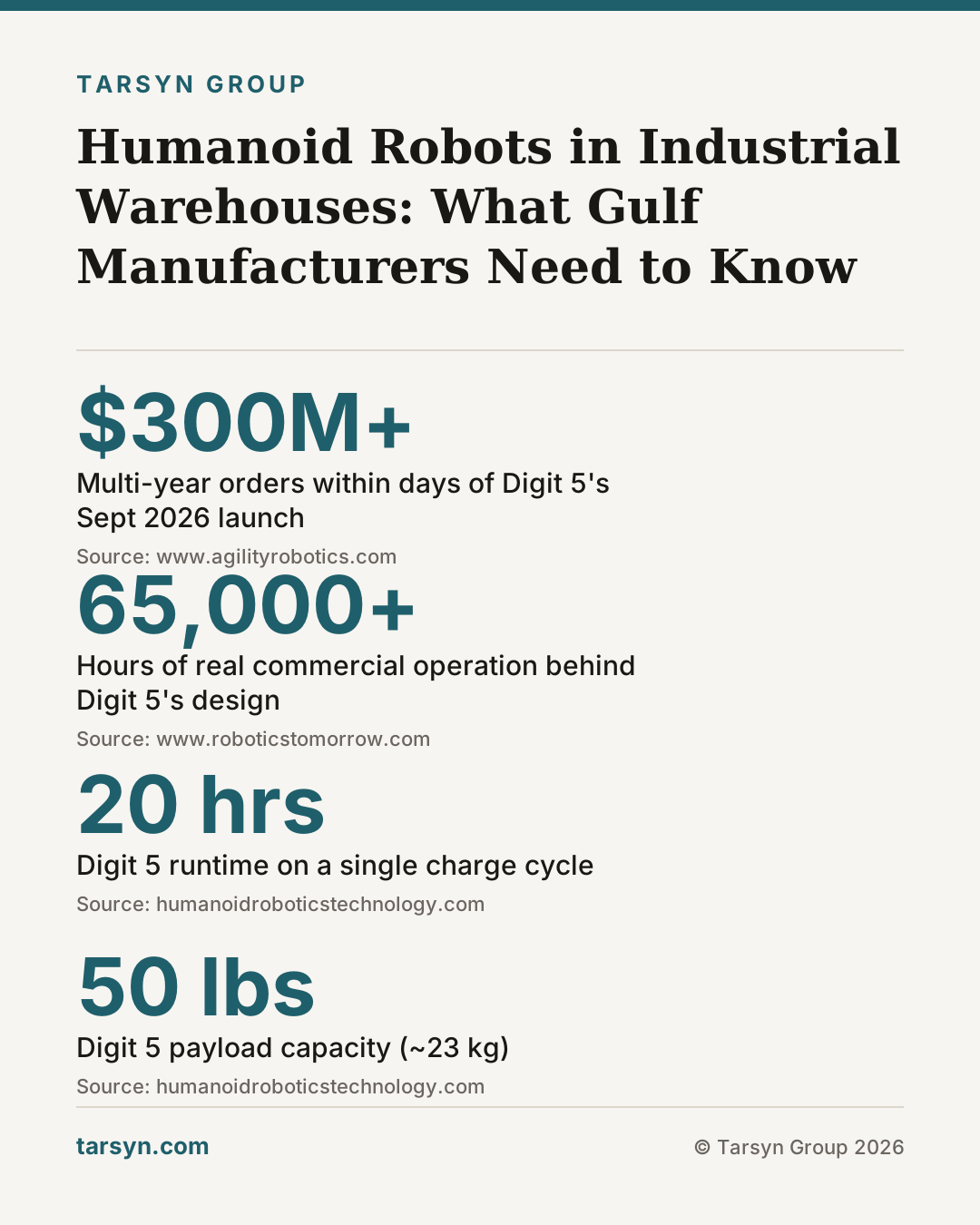
- Digit 5 carries a 50-pound payload for up to 20 hours and is backed by over 65,000 hours of real commercial operation — no longer a prototype metric.
- Agility Robotics has secured more than $300 million in multi-year orders, confirming industrial warehouse automation demand has crossed the commercialisation threshold.
- Gulf recycling and scrap-sorting operations face labour constraints that map directly onto Digit 5's repetitive material-handling capabilities, making it a near-term fit.
- Vision 2030 manufacturing scale-up is compressing the technology adoption window — GCC operators that delay ESG and operational frameworks for physical AI risk being outpaced.
A warehouse in Salem, Oregon is currently running a humanoid robot through full facility workflows — no safety cage, no dedicated lane, no human minder standing by with an emergency stop. That is not a research pilot. Agility Robotics built Digit 5 on the back of more than 65,000 hours of commercial operation, and within days of its September 2026 launch the company disclosed more than $300 million in multi-year orders from manufacturing, warehousing and logistics customers. 1 For Gulf industrials watching the announcement from a distance, the relevant question is not whether this technology is real. It is how quickly it arrives on the production floors they are building right now.
What Digit 5 Actually Does on a Factory Floor
Digit 5 is Agility's first humanoid robot engineered specifically for cooperatively safe work at scale. In practical terms, that means it can move through a working facility — alongside forklift operators, line workers, and pickers — without the physical barriers that have historically made traditional industrial robots impractical for mixed-use spaces. 1
The safety architecture is worth examining in detail because it is what separates Digit 5 from its predecessors. The system runs proprietary AI algorithms across multiple sensor types to continuously detect nearby people and autonomously choose between three responses: avoid, stop, or assume a seated position. A separate, independent safety controller handles these responses so that the robot's primary operating software cannot override a safety-critical decision. Visual and auditory cues broadcast the robot's motion intent so that nearby workers can anticipate its next move. 3
On the operational side, the specifications are:
1. Payload: 50 pounds (approximately 23 kg) 2. Runtime: Up to 20 hours on a single charge cycle 3. Workflow scope: Full facility workflows — not isolated pick-and-place stations 4. Safety certification: First humanoid to pass an independent OSHA field evaluation on a customer production line 1 5. Build basis: Over 65,000 hours of real commercial operation across prior Digit generations 2
A 20-hour runtime matters enormously for shift-based industrial operations. A robot that runs two full shifts before requiring a charge is a robot that can replace or augment labour across the bulk of a working day without adding charging downtime as a hidden throughput cost.
Why This Moment Is Different From Previous Robotics Hype Cycles
Every decade produces a robotics inflection point that turns out to be five years early. The difference in 2026 is that the gap between demo and deployment has closed in a way the numbers support. Agility's CEO Peggy Johnson framed it precisely: "We built it to the exact requirements our customers gave us after three years of Digit 4 working on their production floors. The market has responded with more than $300 million in multi-year orders." 2
Multi-year orders from industrial customers are not research grants. They are procurement decisions made by operations managers who have already run a prior generation of the product and know their total cost of ownership model. That is the signal that separates this cycle from the cobots-will-replace-everyone announcements of 2016.
Three structural factors are also different this time. First, AI inference hardware is now cheap enough that a mobile robot can carry its own decision-making compute rather than relying on a wired edge server. Second, foundation models trained on human motion data have dramatically shortened the programming cycle for new tasks — a robot can now generalise across novel objects and layouts rather than requiring bespoke scripting for every SKU. Third, the labour economics in high-cost logistics markets have shifted far enough that humanoid robots approach payback periods that industrial capital committees will approve.
For Gulf operators, there is a fourth factor: the Vision 2030 manufacturing build-out is generating new facilities from a blank sheet. Embedding humanoid-compatible layouts and digital infrastructure at the design stage costs a fraction of retrofitting existing lines.
The Circular-Economy Case: Robots in Scrap Sorting and Material Handling
The strongest near-term use case for Gulf industrial operators is not final assembly. It is the category that already costs the most in labour and produces the highest injury rates: repetitive material handling in secondary materials processing and scrap sorting.
Saudi Arabia's manufacturing expansion is generating growing volumes of industrial scrap and production waste that require sorting, grading, and routing — exactly the kind of variable, physically demanding, high-repetition work that has historically resisted full automation. See our analysis of this gap: Saudi Local Manufacturing Is Growing — So Is Its Recycling Problem.
A humanoid robot with a 50-pound payload can lift and transfer sorted scrap bales, reposition containers between processing stages, and operate in the open-floor environments typical of scrap yards and recycling facilities — spaces where cage-based automation was never viable. The cooperative safety architecture means it can work in the same bay as human graders without line redesign.
This matters for ESG as well as productivity. A documented, sensor-tracked robot produces a data trail of material flows that a human-operated process does not. That data trail is precisely what IFRS S1 and S2 sustainability reporting will require Gulf industrials to produce — a compliance pressure that is already moving toward enforcement deadlines. Automation and ESG data infrastructure are the same capital decision, if operators frame it correctly.
The visual AI layer is equally relevant here. Visual AI systems are already hitting Gulf recycling and manufacturing floors, and Digit 5's sensor stack integrates with the same data architectures those systems use. A facility that has already deployed visual AI for quality inspection and material classification is two-thirds of the way to being Digit-compatible.
GCC Readiness: Infrastructure, Regulation, and the Vision 2030 Tailwind
The GCC is not a uniform market for industrial warehouse automation. There are at least three distinct readiness tiers.
Tier 1 — New greenfield facilities: Projects under NEOM, Alat, and affiliated Vision 2030 industrial zones are being designed with digital infrastructure as a baseline requirement. Alat's $100 billion manufacturing commitment explicitly targets advanced manufacturing. These sites can embed humanoid-compatible floor layouts, charging infrastructure, and connectivity from day one.
Tier 2 — Existing large-format industrial operations: Petrochemical complexes, port logistics hubs, and major recycling facilities have the capital structures and operations management maturity to evaluate physical AI as a procurement category. The challenge here is change management and workforce transition planning, not capital access.
Tier 3 — SME manufacturers and mid-size processors: These operators face longer payback timelines and less internal technical capacity. For them, the near-term play is preparing the data and ESG infrastructure — so that when humanoid robots reach a price point that works for smaller operations, the integration cost is not doubled by legacy data gaps.
On the regulatory side, the GCC does not yet have a harmonised framework for humanoid robot deployment on industrial sites. The OSHA-based safety evaluations Agility has passed apply to U.S. jurisdictions. Gulf operators will need to engage local authorities — in Saudi Arabia, this runs primarily through the Ministry of Industry and Mineral Resources and the Standards, Metrology and Quality Organization (SASO) — to map existing machinery safety standards to physical AI deployments. This is not a blocking issue, but it is a process that takes time, and operators who wait until the procurement decision to start regulatory engagement will lose 12 to 18 months unnecessarily.
The GCC's infrastructure investment cycle also creates an indirect tailwind. The region's $20.7 billion infrastructure programme is generating demand for secondary materials and creating new logistics nodes — both of which are adoption contexts for industrial automation.
Tarsyn's View: How Gulf Industrial Operators Should Evaluate Physical AI Now
The Digit 5 announcement is not a technology curiosity. It is a capital planning signal.
The $300 million in multi-year orders tells us that large industrial customers have already crossed the internal approval threshold. 1 Gulf operators who are not yet asking the question are already behind their international peers in building the institutional knowledge to evaluate it.
Our position is that the evaluation should happen in three stages, run in parallel rather than sequence:
1. Task mapping: Identify the five highest-cost, highest-injury-risk repetitive tasks on each facility's floor. Score them against the Digit 5 capability profile — payload, cycle time, floor space requirements, proximity to human workers. This produces a shortlist of deployment candidates without any capital commitment.
2. Data and ESG infrastructure readiness: Physical AI generates a continuous stream of operational and environmental data. Operators who have not yet built their sustainability data infrastructure are not ready to capture the ESG value of automation — and in a post-IFRS S1/S2 environment, uncaptured ESG value is a reporting liability. AI is already transforming industrial procurement data — physical AI simply raises the stakes.
3. Regulatory pre-engagement: Start the conversation with relevant Saudi or UAE authorities now. Map Digit 5's OSHA-validated safety architecture to local standards. Identify any gaps. This work costs almost nothing and compresses the eventual deployment timeline significantly.
The operators who will benefit most from physical AI are not necessarily those with the largest capital budgets. They are those who have done the analytical work before the technology arrives at their gate. That work is available today, and the cost of not doing it compounds every quarter that Vision 2030 projects come online without a physical AI readiness framework in place.
Talk to Tarsyn Group about building your operational and ESG readiness for physical AI adoption.
- Agility Unveils Digit 5 Humanoid Robot Built for Cooperatively Safe Work at Scale | Agility — www.agilityrobotics.com
- Agility Robotics Unveils Digit 5 Humanoid Robot Built for Cooperatively Safe Work at Scale | RoboticsTomorrow — www.roboticstomorrow.com
- Agility Announces Digit 5 Humanoid Robot — humanoidroboticstechnology.com