GCC's $20.7bn Infrastructure Wave: The Secondary Materials Play
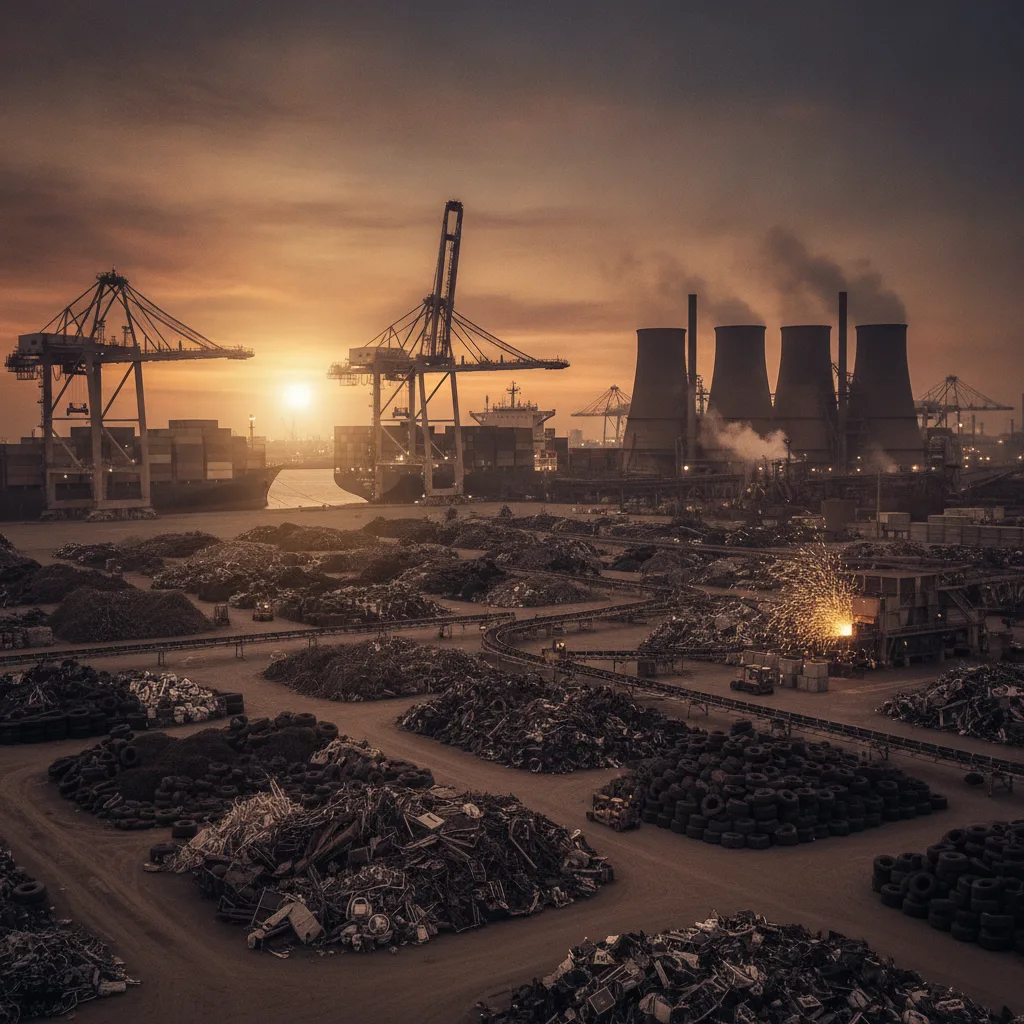
- GCC investments in water, circular economy, logistics and smart transportation are projected to hit $20.7bn by 2030, generating proportional outflows of scrap steel, rubber, and process waste at every project phase.
- The GCC produces more than 150 million tonnes of waste per year, yet secondary raw materials recovery remains structurally underdeveloped compared to established global markets.
- Secondary steel in the GCC trades at a meaningful discount to virgin hot-rolled coil, making recovered scrap a direct margin lever for any operator willing to build recovery into procurement contracts.
- Circular procurement frameworks — specifying secondary material off-take at contract award, not project close — are the single fastest route for Gulf developers to cut input costs and meet national ESG targets simultaneously.
At a port in Jebel Ali or a desalination site outside Riyadh, the question is the same: when this project winds down, where does the steel go? The honest answer, across most Gulf megaprojects today, is landfill or low-value scrap export — not because recovery is technically impossible, but because nobody wrote it into the contract.
That gap is about to become expensive. GCC investments in water, circular economy, logistics, and smart transportation are projected to reach $20.7bn by 2030 1. Every billion committed to pipelines, port cranes, and smart transport corridors is a future inventory of secondary raw materials — steel, aluminium, rubber, copper, process chemicals — waiting to be mismanaged or monetized. The choice is structural, and it is made at contract award, not project close.
What the $20.7bn pipeline actually means in material terms
Infrastructure investment doesn't consume materials — it holds them in service for a decade or two, then releases them. A water megaproject involves carbon steel pipe, pump casings, electrical conduit, rubber gaskets, and treatment chemicals. A logistics hub contains structural steel, conveyor rubber, fork-lift batteries, and warehouse racking. When a project phases out, undergoes a major overhaul, or gets replaced under a national upgrade cycle, each of these material categories enters the market as a secondary raw material.
The GCC generates more than 150 million tonnes of waste per year 2, across all sectors. Even a conservative recovery rate applied to the industrial and infrastructure subset of that figure represents tens of millions of dollars in commodity value annually — value that currently leaks out of the regional economy through unmanaged disposal or export at minimal processing margin.
Scale matters here. The $20.7bn investment figure 1 is not a single project; it is a rolling pipeline across six national economies, phasing over the remainder of this decade. That means the secondary material outflow is not a one-time event but a sustained stream with predictable volume and timing — exactly the profile that makes off-take agreements viable and makes spot-market opportunism the inferior strategy.
Where scrap metal and industrial waste enter the supply chain — and when
Recovery opportunities on a large infrastructure project cluster at three distinct moments:
1. Construction close — formwork steel, surplus rebar, off-cuts from pipe fabrication, and packaging waste all concentrate at the final site clearance. This is the largest single event and the easiest to plan for, yet it is routinely handled by whoever wins the demolition subcontract rather than by a materials-recovery specialist. 2. Scheduled maintenance cycles — pump impellers, heat exchanger bundles, filter media, belt segments, and electrical switchgear are replaced on fixed schedules. Each replacement produces a predictable parcel of recoverable material. Operators who track asset registers can forecast these flows 12–18 months out. 3. Technology replacement — when a national program upgrades desalination from multi-stage flash to reverse osmosis, or swaps diesel port equipment for electric, entire equipment categories become secondary inventory simultaneously. These events are announced years in advance in national development plans.
None of these moments is unpredictable. All three can be contracted around. The failure to do so is not a logistics problem — it is a procurement design failure.
Why secondary materials recovery is still an afterthought on Gulf megaprojects
Procurement teams on Gulf megaprojects are evaluated on delivery: capacity commissioned on time, budget held, safety record clean. The exit value of materials is nobody's KPI. End-of-project waste disposal is either bundled into a lump-sum demolition contract or left to site management to sort out under time pressure.
Compounding this is the historically low cost of landfill in the GCC. When tipping fees are negligible, the financial case for diverting materials to a recovery chain — which requires logistics, sorting, and a buyer relationship — struggles to compete on pure cost grounds. The incentive structure rewards disposal speed, not resource value.
The regional circular economy is changing that calculus, but unevenly. As noted by recycling and sustainability specialists in the region, the Middle East's circular economy journey is still in its early stages compared to more established global markets 2. National vision frameworks in Saudi Arabia and the UAE have elevated circular economy to a strategic priority, but translating policy intent into project-level procurement clauses is a gap that remains wide on most active site programmes.
There is also a structural market liquidity problem. A project manager in Kuwait cannot easily discover the current bid price for 400 tonnes of recovered pump-casing steel, or who will take a parcel of mixed conveyor rubber. Without visible price discovery and a known counterparty, the rational move remains disposal.
The economics: secondary materials vs. virgin commodity pricing in the GCC today
Secondary steel — recovered structural sections, plate, and pipe — trades at a discount to virgin hot-rolled coil. The exact spread varies by grade, condition, and destination market, but the directional case is consistent: any tonne of steel that enters a recovery chain rather than a landfill preserves commodity value that would otherwise be destroyed. For a large infrastructure operator managing thousands of tonnes of steel assets over a project's life, the aggregate opportunity is material on the balance sheet.
Rubber and polymer recovery follow a similar logic. Conveyor belting, pipe insulation, and gasket material have established secondary markets across the GCC, primarily feeding the regional construction sector and export channels to South and Southeast Asia. The challenge is minimum parcel size: small volumes are uneconomical to sort and transport; large, aggregated volumes attract competitive bids.
This is where trading scale matters. An operator that can aggregate secondary material flows across multiple project sites — or across a region — can reach the minimum efficient volume that transforms a disposal cost into a revenue line. For Gulf buyers and developers, the question is whether they have that aggregation capability in-house or need a commercial partner with regional reach and commodity market access.
Understanding how broader trade dynamics affect these material values is also essential. Shifts in global recycling trade — including tariff changes affecting scrap flows — directly influence the price a GCC operator can realise on recovered material. What US double-digit tariffs mean for GCC recycling trade is a live variable in any secondary materials financial model today.
Tarsyn Group's view: infrastructure scale demands circular procurement from day one
The $20.7bn pipeline is a procurement decision waiting to be made correctly or badly. Tarsyn Group's position is specific: secondary material off-take must be specified at contract award, not project close.
This is not an ideological statement about sustainability — it is a commercial one. A developer who writes secondary material recovery terms into an EPC or O&M contract retains negotiating leverage. The materials are identified in advance, volumes are estimated from asset registers, and a counterparty is lined up before the materials become a disposal problem under deadline pressure. That sequence produces better prices, lower disposal costs, and a defensible ESG narrative that is grounded in documented material flows rather than reported intent.
The GCC's circular economy ambitions — embedded in Saudi Vision 2030, UAE Net Zero 2050, and Kuwait's National Development Plan — will increasingly be tested against project-level evidence. Institutional investors, export credit agencies, and sovereign wealth fund co-investors are all developing more granular sustainability due diligence frameworks. A megaproject that cannot account for its end-of-life material flows will face harder questions in the next financing round.
Tarsyn Group operates at the intersection of Gulf commodity trading and industrial operations. We source, aggregate, and trade secondary raw materials across the region, and we advise developers and operators on how to build circular procurement into project structures before groundbreaking — not after. For developers and industrial buyers evaluating their material strategies on active or planned projects, the earlier that conversation starts, the more value is preserved.
The circular economy intelligence expanding across the GCC — including new entrants like Blue Planet's Dubai operations — signals that the infrastructure for secondary materials recovery is maturing. The gap is not technology or market access; it is procurement intent. Closing that gap is what Tarsyn Group's advisory practice is built to do.
Industrial operators looking to understand how digital tools can further sharpen procurement decisions should also consider reading AI in Industrial Procurement: What Gulf Operators Must Demand — procurement discipline and circular design are mutually reinforcing, not competing priorities.
The $20.7bn wave is already moving. The secondary materials it carries will either be recovered deliberately or disposed of carelessly. The difference is a contract clause written before the concrete is poured.
- Kuwait Times - GCC investments in water, logistics sectors... — www.facebook.com
- Circular Economy in the Middle East: Turning Waste into Value — www.recyclingexpome.com