AI in Industrial Procurement: What Gulf Operators Must Demand

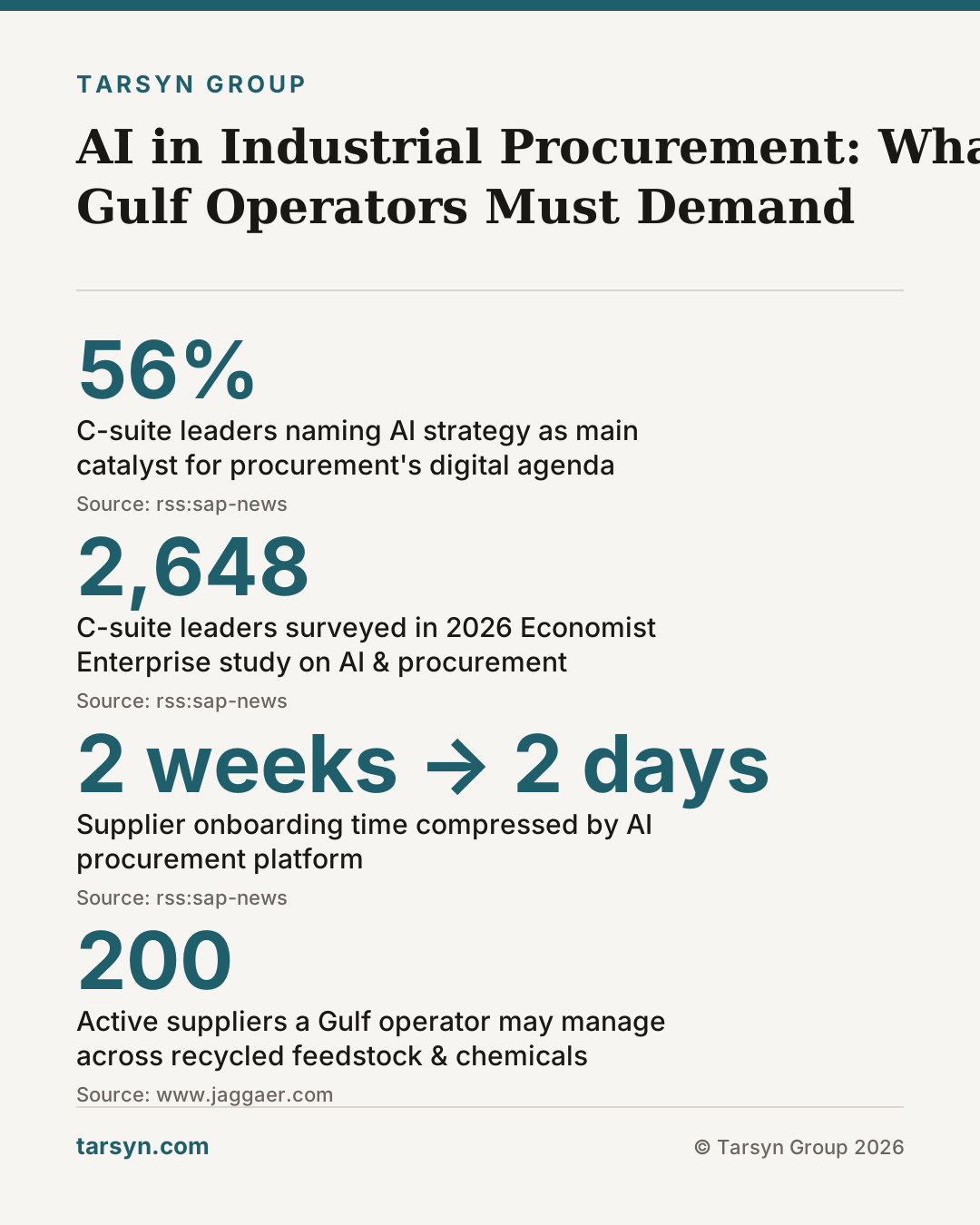
- 56% of C-suite executives in a 2,648-leader study named AI strategy the main catalyst for procurement's digital agenda — yet confidence in translating that investment into measurable outcomes has fallen.
- For Gulf commodity traders, fragmented master data across port manifests, recycled-feedstock grades, and multi-corridor supplier records is the single largest barrier to AI procurement value.
- AI's second procurement role — ESG traceability and CBAM carbon-border compliance — is now commercially material, not optional, for operators exporting processed materials into EU markets.
- Supplier risk in industrial supply chains surfaces only after a failure: AI-powered continuous monitoring can flag financial, ESG, and operational signals before a shipment is delayed or a regulator arrives.
A Gulf metals trader recently described their AI procurement rollout in three words: "fast, then useless." The platform compressed supplier onboarding from two weeks to two days — impressive on a slide — and then began generating price alerts and spend analyses that nobody trusted because the underlying commodity classification data was a patchwork of three legacy systems and two spreadsheet conventions. The AI did not fail. The data did.
That story is not unusual. It is, in fact, the modal outcome of industrial AI procurement projects in 2026.
The Promise vs. the Reality: Why Most AI Procurement Projects Stall
The technology case is not in question. AI can compress work that once took days into minutes — spend analysis, contract review, supplier risk identification, compliance checking 1. The business case, stated plainly, is real.
What is also real is the accountability gap that opens whenever procurement acts faster without a proportional improvement in data quality and governance. A 2026 Economist Enterprise study of 2,648 C-suite leaders found that 56% named AI strategy as the main catalyst for procurement's digital agenda 1. The same study recorded falling confidence in the function's ability to translate those technology investments into consistently better outcomes 1.
That divergence — high ambition, declining confidence — is the diagnostic. Procurement teams are selecting tools before they have defined outcomes. SAP's own guidance, drawn from this research, is blunt: start with the outcome, not the technology 1. A sourcing team shortening event preparation has different data requirements than a category manager who needs early warning of feedstock price shifts. Conflating those objectives and deploying a single AI layer across both is how projects become expensive dashboards.
Where the Gap Is Sharpest for Commodity and Recycled-Materials Traders
Generic procurement AI is built on the assumption that your supplier master data is reasonably clean, your spend categories are consistently coded, and your material specifications are stable. Gulf industrial operators — particularly those trading secondary metals, recycled plastics, or processed industrial by-products across corridors spanning South Asia, East Africa, and Europe — violate all three assumptions simultaneously.
Feedstock grades vary by shipment. Port documentation uses different classification systems than warehouse intake records. Supplier records accumulated across years of spot trading carry inconsistent entity names, duplicate entries, and currency mismatches. When AI ingests that data, it does not average out the noise — it amplifies it. A price-trend model trained on miscategorized commodity grades will produce confident-sounding projections that are structurally wrong.
The volatility dimension compounds this. As explored in our analysis of US tariff impacts on GCC recycling trade, the secondary materials corridors that Gulf operators depend on are subject to sharp regulatory and tariff shifts. An AI system that cannot reliably identify which supplier is shipping which material grade from which jurisdiction is not a risk management tool. It is a liability.
The Data-Quality Problem No Vendor Slide Deck Mentions
Vendor demonstrations run on clean, pre-prepared datasets. Production environments do not. The practical sequence that actually works is: audit the data first, define the outcome second, select the tool third.
This is not a technology critique — it is an operational reality that applies to every AI deployment in procurement. ESG reporting teams have learned this lesson the hard way: sustainability data spread across finance, procurement, HR, and supplier systems produces fragmented, inconsistent, and often unauditable disclosures 2. The fix is governed data consolidation before AI is applied, not after 2.
For industrial procurement specifically, the minimum viable data foundation before any AI deployment includes: a single, deduplicated supplier master with consistent entity names and jurisdiction tagging; commodity classifications aligned to a single taxonomy (HS code or equivalent); and historical transaction records cleaned to remove duplicate purchase orders and currency errors. That work is unglamorous. It is also where the value is created.
Supplier risk intelligence faces the same prerequisite. AI-powered continuous monitoring — tracking financial instability, ESG breaches, cyber incidents, and geopolitical exposure across a supplier base — operates on the premise that you know who your suppliers actually are 4. Supplier risk rarely arrives with advance warning; by the time it becomes visible through conventional channels, options are limited and response costs are high 4. But the monitoring system's signal quality is a direct function of how clean and complete the supplier master data underneath it is.
AI's Second Role: ESG Traceability and CBAM Compliance Pressure
There is a second procurement problem that AI is well-positioned to solve — and it is arriving faster than most Gulf operators have planned for.
Carbon Border Adjustment Mechanism (CBAM) obligations are moving from transition phase toward full operationalization for EU-bound exports of steel, aluminium, and processed materials. That means embedded-carbon data at the material level, traceable to the point of production, is shifting from a reporting aspiration to a commercial prerequisite. Buyers who cannot provide it face tariff penalties. Suppliers who cannot evidence it lose contracts.
Generative AI tools can consolidate sustainability data held across procurement, finance, and supplier systems, reduce manual reporting work, and improve the audit-readiness of disclosures 2. The gain is consistency, traceability, and the ability to produce defensible evidence trails across compliance workflows 2. Supply chain AI platforms are now explicitly positioning around this: CBAM compliance, Scope 3 carbon footprinting, and EU supply chain due diligence are named capabilities, not roadmap items 3.
The catch is the same one that applies to procurement AI generally: those outputs are only as reliable as the data going in. An AI-generated CBAM declaration built on supplier carbon data that has not been verified is not a compliance document — it is an audit risk. The connection between data quality and ESG traceability is not a philosophical point. It is a commercial one.
For operators already thinking through the carbon cost implications of industrial technology at scale, our piece on AI's power consumption and carbon cost for industrial operators provides relevant context on the energy-side of the equation.
Continuous Supplier Monitoring: The Operational Case
Beyond data foundations and ESG traceability, AI's most operationally mature use case in industrial procurement is continuous supplier intelligence. Traditional supplier risk management is periodic — an annual review, a qualification audit, a credit check at onboarding. By the time those reviews surface a problem, the exposure is already real.
AI-powered monitoring ingests public and commercial signals — financial filings, news feeds, regulatory actions, logistics data — and flags anomalies against a supplier's historical baseline 4. For a Gulf operator managing 200 active suppliers across recycled feedstock, scrap metal, and industrial chemicals, that kind of continuous coverage is not achievable manually. It is the operational case for AI that has the clearest ROI line: earlier warning means more response options and lower recovery costs.
The monitoring layer also feeds ESG compliance. Identifying a supplier with a new regulatory citation or a labor-related news flag before a shipment departs is the difference between proactive substitution and reactive disclosure. As the EU's supply chain due diligence frameworks extend their reach, that early-warning function becomes a compliance mechanism, not just a procurement optimization 3.
Operators navigating these intersecting pressures — from waste gas valorization in circular economy supply chains to broader sustainable cost reduction strategies for Saudi industrial operators — are increasingly finding that procurement data infrastructure is the common enabler across all of them.
Tarsyn Group's View: What Gulf Industrial Buyers Should Actually Require from AI Procurement Tools
The framing most vendors offer is capability-first: here is what our platform can do. The framing Gulf industrial buyers should insist on is accountability-first: here is what we will guarantee when your data looks like this.
Three requirements should be non-negotiable before any contract is signed.
First, a pre-deployment data audit. Not a vendor assessment of your readiness — an independent audit of supplier master data completeness, commodity classification consistency, and transaction record integrity. Any vendor unwilling to make their tool's performance conditional on data quality is selling potential, not outcomes.
Second, explicit ESG traceability outputs. The platform must produce structured, auditable carbon and compliance data at the material and supplier level, mapped to CBAM and relevant EU reporting frameworks. "Supports ESG reporting" is not a specification. The specific data fields, verification methodology, and audit trail format must be contractually defined.
Third, continuous monitoring with defined escalation protocols. Supplier risk signals — financial, operational, ESG — must surface in real time, not in quarterly batch reports. And the escalation pathway (who sees the alert, what decision authority they hold, what the response options are) must be designed before the system goes live, not after the first alert is ignored.
The AI exists. The use cases are proven. What most Gulf industrial procurement functions are missing is the sequence: data quality before deployment, outcome definition before tool selection, governance design before go-live. Getting that sequence right is not a technology project. It is an operational discipline — and it is where the value actually sits.
For operators ready to work through that sequence with advisors who operate in the same commodity corridors, speak with Tarsyn Group's advisory team about building a procurement data and sustainability operations foundation that AI can actually run on.
!AI in Industrial Procurement: What Gulf Operators Must Demand — the numbers at a glance
- AI’s Dual Role in Procurement Transformation — rss:sap-news
- Using Generative AI for ESG Reporting and Data Quality — deployflow.co
- AI in Supply Chain Sustainability: Building Data Foundations for 2026 — www.integritynext.com
- AI Supplier Intelligence & Risk Monitoring | JAGGAER — www.jaggaer.com