Sustainable Cost Reduction for Saudi Industrial Operators
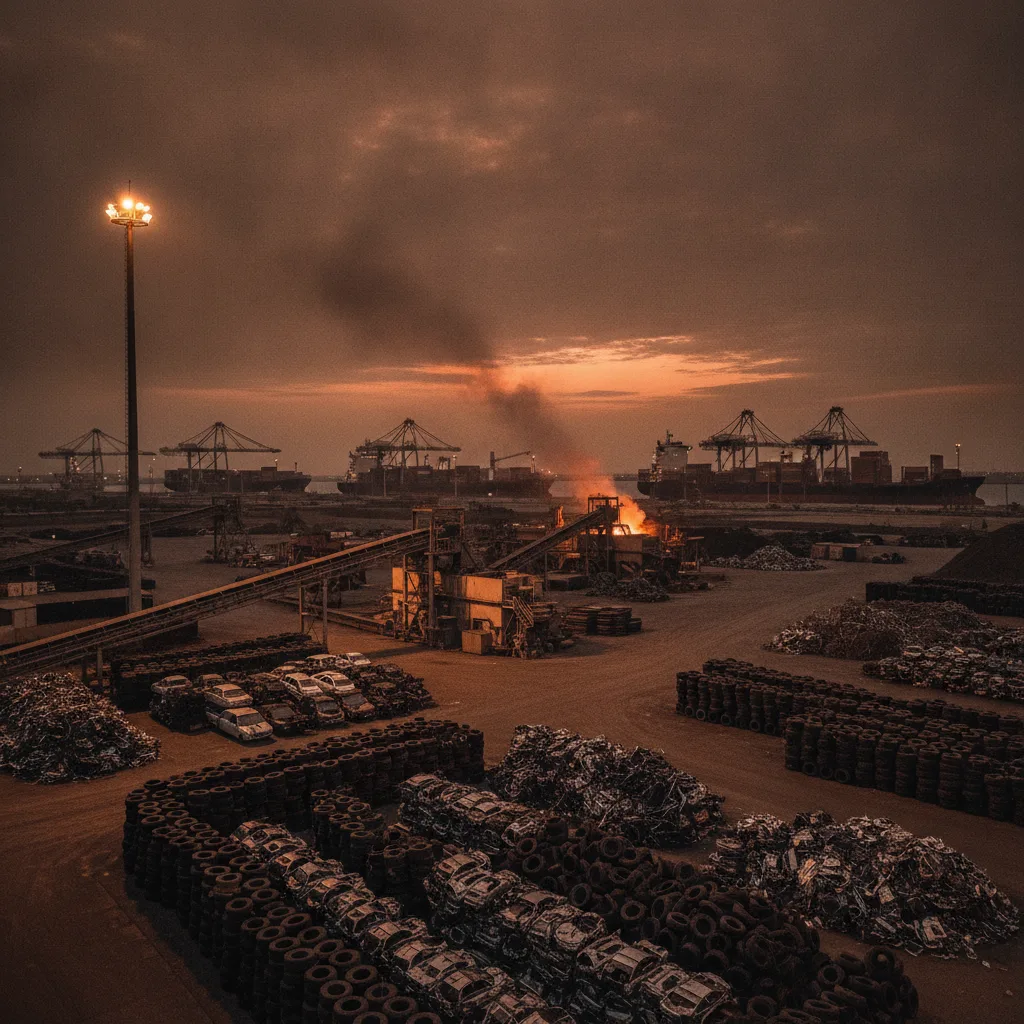
- The GCC generates over 150 million tonnes of waste annually — a recoverable cost asset most industrial operators still treat as disposal overhead.
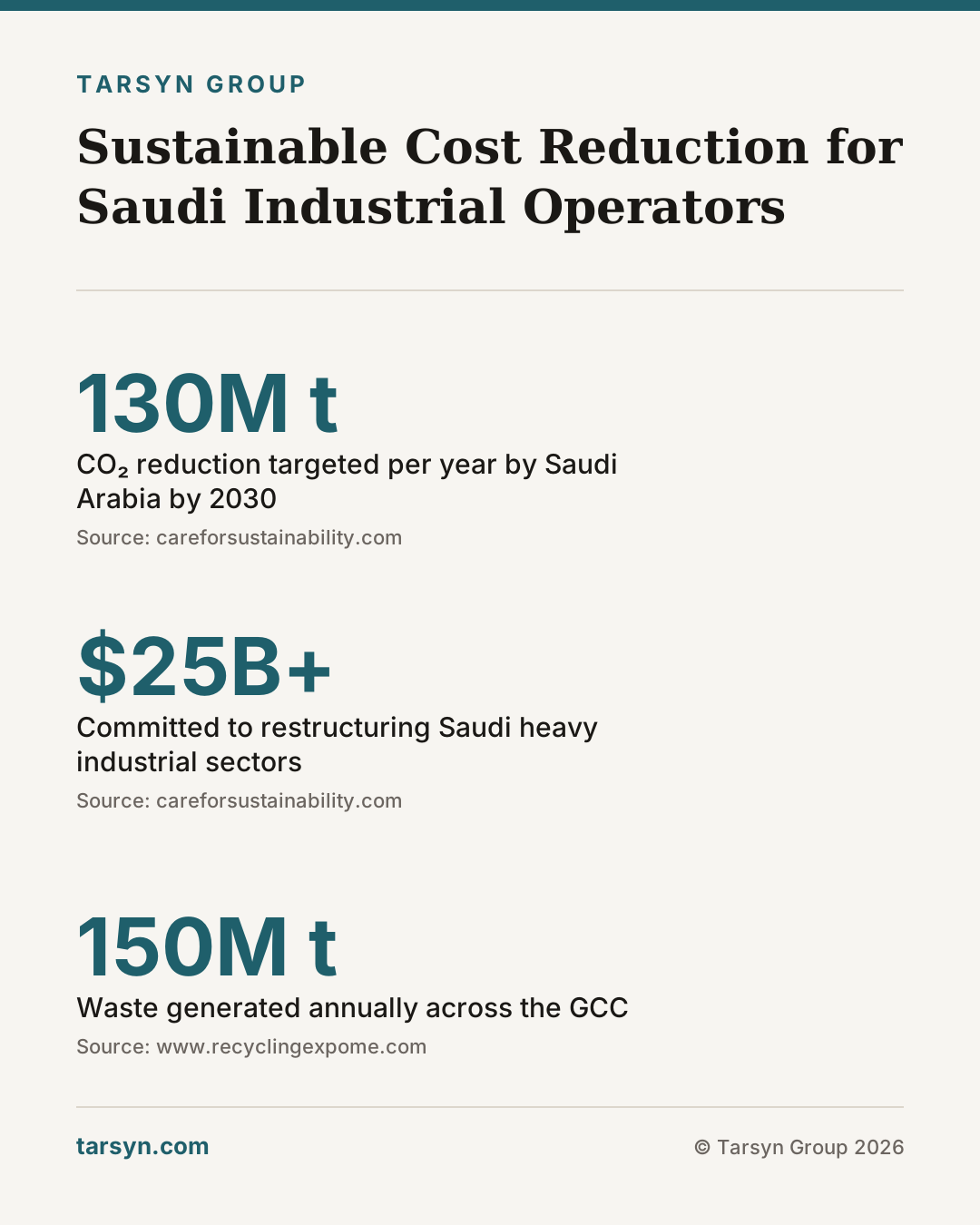
- Saudi Arabia's industrial decarbonisation strategy targets a 130 million-tonne annual CO₂ reduction by 2030, with more than $25 billion in committed heavy-sector investment.
- Scrap metal reuse, rubber-to-fuel offtake, and secondary raw-material loops each address input costs and regulatory compliance simultaneously — not sequentially.
- Vision 2030 EPR timelines and incoming CBAM-style trade barriers make early circular-economy movers structurally cheaper to operate than late adopters.
A steel fabricator in Jubail pays to haul ferrous offcuts to a landfill every quarter. A tyre retreader in Riyadh stockpiles waste rubber with no offtake arrangement. A cement plant outside Jeddah buys virgin aggregate while disposing of process fines that meet secondary-material specifications. Each of these is the same decision: treating a recoverable asset as a cost, then separately budgeting for a sustainability programme that might address it in year three. Saudi industrial operators running this playbook are about to find it expensive in two directions at once.
The cost-and-compliance double bind facing Saudi industry
Vision 2030's industrial ambitions are real and funded. The Kingdom's decarbonisation strategy targets 130 million tonnes of CO₂ reduction per year by 2030, with more than $25 billion committed to restructuring heavy sectors — petrochemicals, steel, cement, and aluminium manufacturing — so they operate within tightening emissions envelopes. 3 That investment timeline is not optional for operators inside the regulated sectors; compliance deadlines advance regardless of commodity cycles or capital availability.
Simultaneously, the GCC's waste generation creates the other side of the equation. The region produces more than 150 million tonnes of waste annually, much of it from industrial and construction activity — material that carries both disposal cost and recoverable value. 1 Most of that value is currently externalised: operators pay to remove it, then purchase virgin equivalents as production inputs.
The double bind is this: compliance programmes that do not generate recovered material value require net new spending. Compliance programmes that are structured around circular-economy integration reduce input costs while satisfying the same regulators. The former is overhead; the latter is operational redesign.
The circular-economy moves that actually cut operating costs
Three material loops are immediately applicable for most Saudi heavy-industry sites — and each has a measurable USD/tonne argument before any regulatory credit is included.
1. Scrap metal reuse and offtake Ferrous and non-ferrous arisings from fabrication, maintenance, and end-of-line processes represent a direct substitute for primary metal purchases. A site that grades its scrap, segregates it by alloy, and establishes a certified offtake arrangement converts a disposal line-item to either net revenue or feedstock cost reduction. The spread between primary and secondary metal prices creates the margin; the consistency of the offtake creates the planning certainty.
2. Rubber-to-fuel and rubber-to-material processing Waste tyre and process rubber accumulations are a logistics and fire-hazard liability at most industrial sites. Pyrolysis-based rubber-to-fuel conversion produces synthetic diesel and carbon black — both tradeable commodities — from material that currently has negative book value. Establishing an offtake agreement with a certified processor eliminates the disposal cost and introduces a product revenue line.
3. Secondary raw-material loops Process fines, off-spec batches, and construction demolition material frequently meet the specification of secondary raw materials for adjacent industries. Cement fines reused as fill or aggregate substitute, process slag sold to road-construction contractors, and aluminium dross processed for refractory applications are all operating in GCC markets now. 1 The barrier is usually the absence of a grading and routing arrangement — not a technical constraint.
What the numbers actually look like
Exact recovered-value figures are site-specific — volume, composition, and logistics drive the arithmetic. But the directional structure is consistent:
| Material stream | Current status (typical) | Circular outcome | |---|---|---| | Ferrous scrap | Disposal cost + lost feedstock value | Offtake revenue or input substitution | | Waste rubber / tyres | Disposal cost + liability | Pyrolysis product revenue | | Process fines / slag | Landfill cost | Secondary-material sale or avoided purchase | | Packaging and industrial plastics | Mixed disposal | Sorted bale offtake |
The input-substitution effect compounds when energy is included. Saudi Arabia's industrial energy costs are rising as domestic subsidy structures evolve — any reduction in process energy consumption through material efficiency or waste-heat recovery directly affects the per-tonne cost of finished product. The decarbonisation investment programme signals that this trajectory continues. 2
Regulatory tailwinds that reward early movers
Three regulatory vectors are converging on Saudi industrial operators within the 2025–2030 window:
Vision 2030 and Extended Producer Responsibility (EPR). Saudi Arabia is advancing EPR frameworks that place legal responsibility for end-of-life material management on producers and industrial operators. Operators with existing circular loops and documented recovery rates will comply with lower incremental cost than those building from scratch.
The Saudi Green Initiative and sectoral targets. The decarbonisation strategy aligns the Saudi Green Initiative's headline commitments with specific sectoral obligations in petrochemicals, steel, cement, and aluminium. 3 The 130-million-tonne CO₂ reduction target by 2030 is not a voluntary aspiration — it is a structural requirement for operators in these sectors to remain commercially viable in export markets.
CBAM-equivalent trade barriers. The EU's Carbon Border Adjustment Mechanism is already in its transitional phase for steel, cement, and aluminium. Saudi exporters in these categories face embedded carbon charges on EU-bound product. Other major markets are developing analogous measures. As we examined in our analysis of US tariffs and GCC recycling trade, the direction of trade policy is consistent: carbon-intensive production faces cost penalties at the border, and those penalties fall directly on operators who have not restructured material flows.
The arithmetic of early adoption is straightforward: operators who integrate circular loops now amortise the operational redesign cost over more years, establish offtake relationships before they become crowded, and arrive at compliance deadlines with documented performance data rather than projected targets.
Tarsyn Group's view: start with your waste streams, not a strategy deck
The sustainable manufacturing conversation in the Gulf has accumulated a significant body of frameworks, roadmaps, and ESG advisory engagements — most of which sit in slide decks while the scrap pile outside the plant gate continues to grow. Tarsyn's position is different because our starting point is different.
We operate as a commodity trader and industrial operator in recovered materials. When we assess a facility, the first questions are commercial: what is coming off this line, in what volume, at what composition, and what is the nearest certified offtake or processing route? The sustainability case follows from the material economics — it is not the premise.
This matters because a plant-floor audit surfaces recoverable value that a strategy engagement misses. The ferrous offcut that looked like waste has a spot price. The rubber stockpile has a pyrolysis offtake market. The process fine has a secondary-material buyer. None of these require a multi-year transformation programme — they require a routing decision and a commercial arrangement.
For operators under Vision 2030 compliance pressure, the sequence is: quantify existing waste streams in tonnes and composition, identify the highest-value recovery route for each, structure offtake, then report the CO₂ and input-cost reduction to regulators. The compliance output is a consequence of the commercial decision, not a separate workstream.
If you want to assess what your current waste streams are worth — and what it would cost to route them correctly — speak to Tarsyn Group's advisory team. The conversation starts with your material flows, not a framework.
!Sustainable Cost Reduction for Saudi Industrial Operators — the numbers at a glance
- Circular Economy in the Middle East: Turning Waste into Value — www.recyclingexpome.com
- Saudi Industrial Decarbonisation Strategy 2025–2030: Vision 2030’s Green Industrial Revolution - CARE - Climate Action & Renewable Energ — careforsustainability.com
- Saudi Industrial Decarbonisation Strategy 2025–2030: Vision 2030’s Green Industrial Revolution – CARE – Climate Action & Ren — careforsustainability.com