Turning Waste Gases into Chemicals: What It Means for Industry
- Rise Reforming (YC S26) converts stranded biogas from landfills, farms, and wastewater plants into DME, methanol, and dimethyl carbonate using modular, shipping-container-sized units.
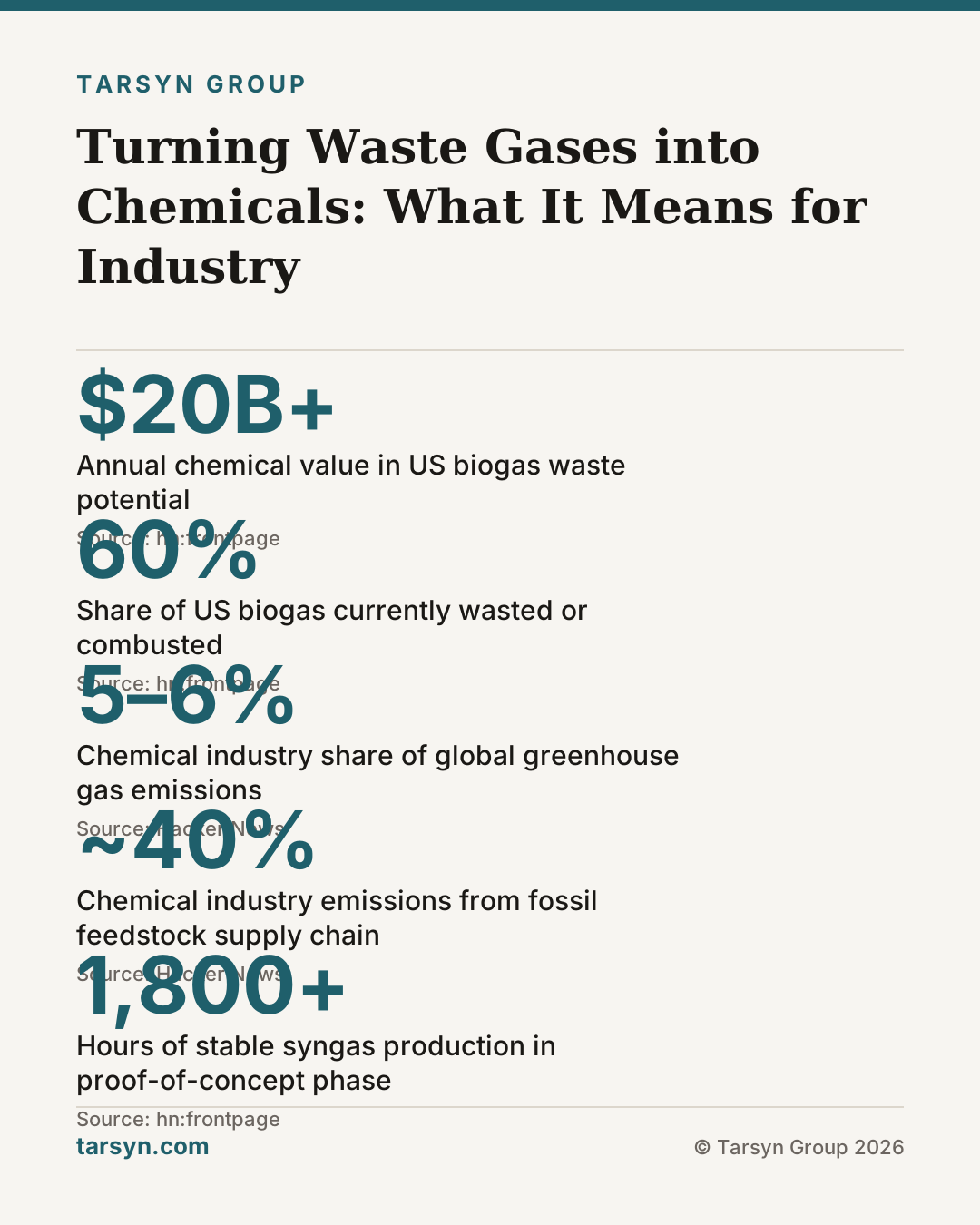
- The US alone produces enough biogas to make over $20 billion worth of chemicals annually, yet 60% is currently wasted or flared in low-margin applications.
- The chemical industry's fossil-fuel dependence accounts for 5–6% of global greenhouse gas emissions, with about 40% of well-to-gate emissions tied to extraction, processing, and transport of feedstocks.
- GCC operators that map their waste gas streams now will be positioned to capture first-mover revenue when modular gas-to-chemicals technology reaches commercial scale in the region.
At a wastewater plant outside Chicago, a shipping-container-sized reactor has just started processing gas that would otherwise be flared. The company behind it, Rise Reforming, joined Y Combinator's S26 batch in July 2026 with a proposition that is straightforward on paper and hard to execute in practice: take the biogas that landfills, farms, and sewage plants routinely waste, and convert it into commodity chemicals — dimethyl ether (DME), methanol, and dimethyl carbonate (DMC) — on-site, at prices that compete with petrochemical production. 1
For GCC industrial operators, the timing and the technology class deserve attention. The invisible exhaust streams that Gulf manufacturers currently flare or vent are about to become a balance-sheet line item.
What Rise Reforming is actually doing — and why it is different from carbon capture
Rise Reforming is not a carbon-capture company. That distinction matters commercially. Carbon capture isolates CO₂ and routes it to storage or industrial reuse — generating no direct revenue from the gas stream itself and carrying a net cost. Rise Reforming's process reforms raw biogas, a methane-rich mixture, directly into saleable chemicals without requiring fossil-fuel feedstocks at any stage. 2
The business model is structured as a two-sided market. The company pays biogas producers — wastewater utilities, farm operators, landfill managers — for their gas. It then sells the output chemicals to industrial buyers. Revenue comes from the spread between feedstock cost and product sale price, not from carbon credits or compliance payments. 2
The technology is modular by design. Each unit fits inside a standard shipping container, which means deployment can happen on existing industrial sites without major civil works, planning delays, or centralised infrastructure. The company completed 1,800-plus hours of stable syngas production during its proof-of-concept phase before moving to a live biogas pilot at its Chicagoland host site. 1
The starting product — DME — is deliberate. DME commands high margins in the cosmetics industry as an aerosol propellant, giving the company a profitable beachhead before it scales toward methanol, which is a far larger volume chemical with broader industrial applications. 2
The scale of the opportunity: how much value do industries currently vent away?
The numbers attached to wasted biogas are substantial. The United States alone produces enough biogas to manufacture more than $20 billion worth of chemicals annually. Yet 60% of that resource is currently wasted or combusted in low-margin applications. 1
The chemical industry's dependence on fossil feedstocks carries a separate cost. It accounts for 5–6% of global greenhouse gas emissions, and approximately 40% of the industry's well-to-gate emissions are generated not in the reactor but in the extraction, processing, and transportation of fossil raw materials. 2 Converting waste gas into chemicals on-site removes that upstream emission burden entirely.
For the GCC, the structural profile of waste gases is different from the US but no less significant. The region's industrial base — refinery off-gases, agricultural biogas from date-palm waste and livestock operations, landfill gas from rapidly expanding urban centres, biogas from large-scale desalination and wastewater treatment — represents a chemical feedstock inventory that is currently almost entirely unmonetised. The question is not whether that resource has value; it is whether the conversion technology can be deployed economically at GCC facility scale.
Where this fits in the circular economy stack: solids, liquids, now gases
The circular economy in the Gulf has, until recently, been primarily a solids conversation. Recycling mandates, extended producer responsibility schemes, and waste-to-energy facilities have focused on plastic, metal, paper, and construction debris. Liquid waste streams — spent lubricants, industrial effluents — have drawn secondary attention. Gas streams have been an afterthought, managed largely through flaring or venting because no cost-competitive on-site conversion pathway existed.
Rise Reforming's technology class changes that calculus. If modular biogas reformers can produce DME and methanol at prices that compete with petrochemical output — which the company claims its proprietary process achieves — then the circular economy stack gains a third tier. 1 Solids get recycled. Liquids get processed. Gases get converted.
For an integrated GCC industrial operator running a food-processing plant, a livestock operation, a wastewater facility, or a packaging line, this means each site's gas emissions become an input to a chemical production process rather than an atmospheric discharge. The internal value capture from that shift, multiplied across a multi-site operation, is material.
This theme is directly connected to how trade and compliance pressures are reshaping GCC recycling and waste economics more broadly — as covered in our analysis of what US double-digit tariffs mean for GCC recycling trade.
The regulatory tailwind: CBAM, UAE Net Zero 2050, and Saudi green industrial targets
The regulatory environment is tightening from multiple directions simultaneously.
The EU's Carbon Border Adjustment Mechanism (CBAM) is already in its transitional phase and will impose full carbon pricing on embedded emissions in exports of steel, aluminium, cement, fertilisers, hydrogen, and electricity from 2026 onward. GCC manufacturers exporting to Europe will face an explicit cost for every tonne of CO₂ equivalent embedded in their products — including upstream emissions from fossil feedstocks. Converting waste gas streams into on-site chemical inputs reduces that embedded-emission count directly.
The UAE's Net Zero 2050 strategic initiative and Saudi Arabia's own green industrial targets are creating domestic compliance pressure alongside the international trade pressure. Across both economies, large industrial emitters are already subject to voluntary and mandatory sustainability reporting frameworks that will only grow more stringent. Waste gas streams that are currently ignored in ESG disclosures will become reportable, then regulated.
The direction of travel is clear. Flaring and venting will attract increasing scrutiny — from regulators, from export partners applying CBAM-equivalent measures, and from institutional investors applying emissions screens to Gulf industrial assets. The question is not whether waste gas monetisation becomes a requirement; it is how quickly that happens relative to when the conversion technology is commercially available at scale.
Tarsyn Group's view: map your gas streams before the technology arrives
Rise Reforming is at pilot stage. Its Chicagoland wastewater plant unit is beginning construction. The jump from a proof-of-concept with 1,800 hours of stable syngas production to a commercially replicable, GCC-deployable modular system will take time — and will require offtake agreements, local regulatory alignment, and logistics infrastructure that does not yet exist in the region. 1
None of that makes this technology irrelevant to Gulf operators today. It makes preparation the correct strategy.
Facilities that spend the next twelve to twenty-four months mapping their waste gas streams — characterising volumes, compositions, flow rates, and seasonal variability — will be positioned to evaluate modular reforming projects on actual data rather than assumptions when the technology becomes commercially available. That matters for three reasons.
First, offtake negotiations for the output chemicals will favour operators who can demonstrate consistent feedstock supply. Second, capex justification for on-site conversion units depends on accurate waste gas characterisation — an undocumented stream cannot be bankrolled. Third, early movers in a two-sided market capture the best commercial terms; waiting until the technology is proven at Gulf-scale means accepting standard market pricing rather than shaping it.
The opportunity sits at the intersection of what Tarsyn Group does operationally: mapping material and energy flows across industrial sites, identifying the streams where value is being discarded, and structuring the commercial and operational pathways to recover it. Waste gas reforming is the next version of that work — and it starts with knowing what you currently flare.
If your operation involves landfill gas, agricultural biogas, wastewater treatment, or refinery off-gases, the time to map those streams is now, not when a container-sized reformer arrives at your gate. Talk to Tarsyn Group about sustainability operations to understand what a waste gas inventory for your facilities would involve and what it could be worth.
The chemical industry has treated its exhaust streams as a cost of doing business for a long time. A YC-backed startup in Chicago is making the case that those streams are, in fact, the feedstock. The GCC's industrial operators would do well to take that case seriously before the technology makes the argument for them.
!Turning Waste Gases into Chemicals: What It Means for Industry — the numbers at a glance