IFRS S1 & S2: What GCC Industrials Must Do Now

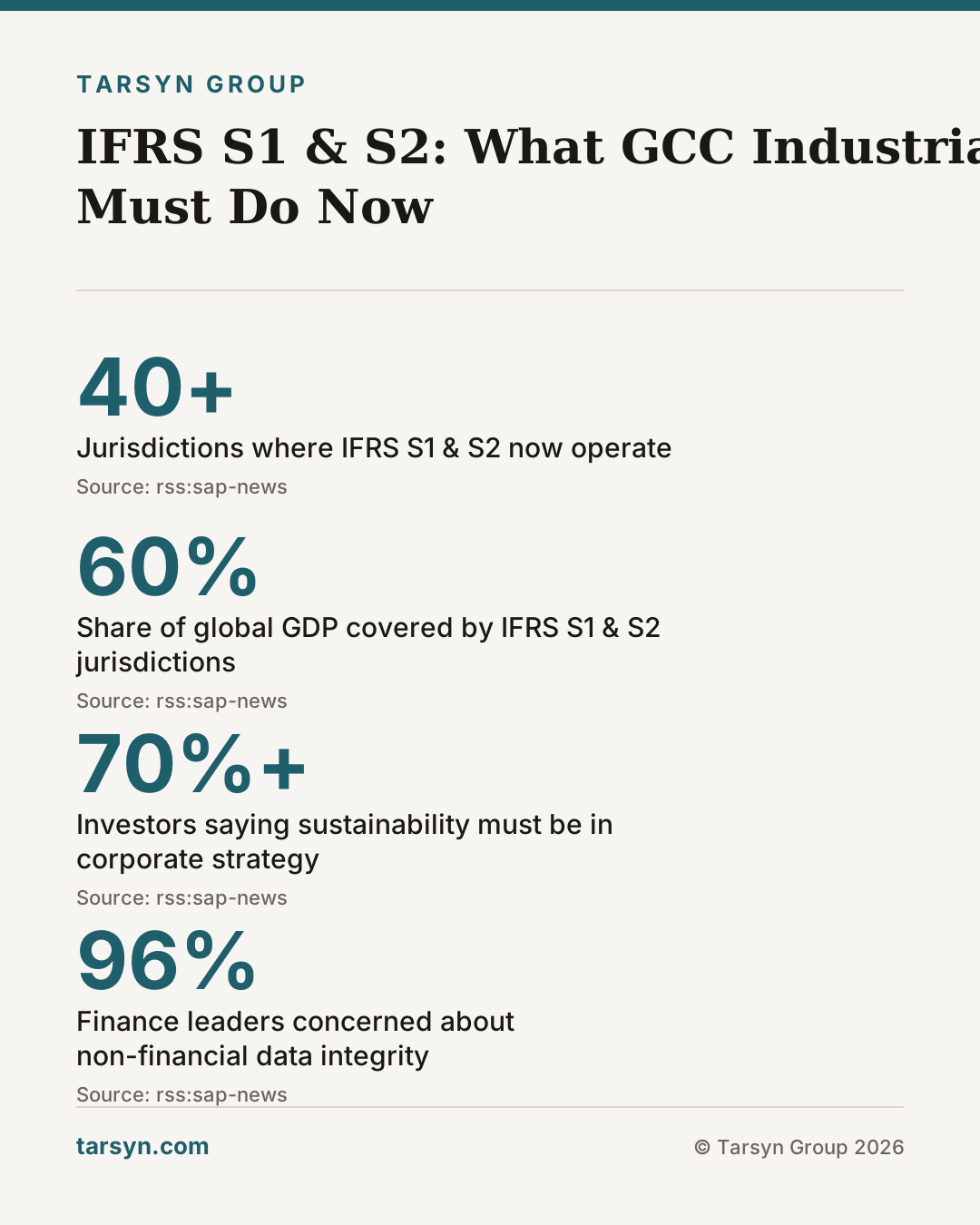
- IFRS S1 and S2 are now adopted across 40+ jurisdictions covering roughly 60% of global GDP, making GCC exporters subject to audit-standard sustainability disclosure through their trading partners.
- Carbon border adjustment mechanisms translate every tonne of unverified CO₂ into a direct tariff line item — GCC manufacturers exporting to the EU face this pricing gap starting from the transition period.
- Four data points — scrap yield by input stream, recycled-content ratio, Scope 1 and 2 emissions per tonne of output, and circular-economy diversion rates — must be locked in auditable systems before first disclosure.
- 96% of finance leaders globally report concerns about the integrity of non-financial data, meaning most GCC operators are already behind the assurance bar these standards demand.
A Gulf steel re-roller ships a container to Rotterdam. The buyer's compliance team flags it: no auditable Scope 1 figure, no recycled-content documentation, no chain-of-custody record from the scrap yard. The shipment clears — this time — but the invoice carries a carbon border adjustment surcharge calculated on the sector's worst-case emissions intensity. That gap, measured in USD per tonne, is no longer hypothetical. It is the commercial consequence of treating sustainability reporting as a communications exercise rather than a data discipline.
What IFRS S1 and S2 actually require — and why 'good intentions' don't pass the audit
IFRS S1 sets the general framework: companies must disclose all sustainability-related risks and opportunities that are reasonably expected to affect enterprise value. IFRS S2 is the climate-specific layer — Scope 1, 2, and 3 greenhouse gas emissions, physical and transition climate risks, and targets with measurable milestones. Together, these standards now operate in over 40 jurisdictions covering roughly 60% of global GDP 1.
The defining shift is assurance. Sustainability data must meet the same traceability and accuracy standards as financial data 1. That means: data sourced from operational systems, not assembled retrospectively from memory and estimates; a clear audit trail from measurement point to disclosed figure; and internal controls that a third-party auditor can test. The PwC Global Investor Survey found that more than 70% of investors say sustainability must be integrated into corporate strategy 1. But the harder number comes from EY: 96% of finance leaders globally report concerns about the integrity and reliability of their organisation's non-financial data 1. Most companies are already failing the bar these standards set — and many do not know it yet.
For GCC manufacturers, the urgency is compounded by regional adoption momentum. Corporate sustainability reporting in the Gulf has moved rapidly from voluntary practice to a regulated corporate priority 4, with capital markets in the UAE, Saudi Arabia, and Qatar aligning disclosure expectations with ISSB standards 2. A company that exports to Europe, issues bonds in a regulated market, or sits in the supply chain of a multinational now faces these requirements through its counterparties — even if local regulation has not yet mandated them directly.
The CBAM connection: how carbon-reporting gaps become tariff exposure
The EU's Carbon Border Adjustment Mechanism (CBAM) prices embedded carbon in imported goods — steel, aluminium, cement, fertilisers, hydrogen, and electricity are in the initial scope. The mechanism is designed so that an importer who cannot produce verified embedded-emissions data defaults to the EU's worst-case sectoral average for that product category. That average is almost always higher than the actual figure for a modern, scrap-fed GCC operation.
The connection to IFRS S2 is structural. The emissions accounting methodology that CBAM requires at the product level is the same methodology that IFRS S2 demands at the company level. A manufacturer that has built auditable Scope 1 and Scope 2 systems for IFRS disclosure already holds the data infrastructure needed to calculate and defend CBAM-compliant embedded-carbon figures. One that has not faces a double cost: the tariff gap on current shipments, and the build cost of data systems under deadline pressure.
This is not a future scenario. The CBAM transitional period — during which importers must report but are not yet charged — is a data-collection window, not a reprieve 3. GCC industrial exporters who use that window to build auditable systems will convert a compliance burden into a competitive advantage. Those who treat it as a delay will face both the tariff and the infrastructure cost simultaneously.
For more on how parallel trade-policy pressures are reshaping GCC commodity flows, see US Tariffs 2025: What Double-Digit Tariffs Mean for GCC Recycling Trade and PPWR Tightens: What Gulf Traders Must Know Now.
Four data points every GCC recycler and manufacturer must lock down first
Organisations facing both IFRS S2 and carbon border mechanism scrutiny do not need to solve everything at once. Four data points carry the highest audit risk and the most direct trade exposure:
1. Scrap yield by input stream. For re-rollers, foundries, and recyclers, the ratio of finished output to raw scrap input — disaggregated by material grade and source — is the foundation of both carbon intensity and recycled-content calculations. If this number lives in a foreman's logbook rather than an ERP system, it cannot be assured.
2. Recycled-content ratio at the product level. IFRS S2 and CBAM both require product-level granularity. An aggregate company-wide recycled-content figure is not sufficient. Each product family needs a traceable calculation, with evidence linking back to procurement records.
3. Scope 1 and Scope 2 emissions per tonne of output. Energy consumption is the one sustainability metric that most GCC manufacturers can already meter. Converting metered energy into a tonne-of-output intensity figure, split by Scope 1 (direct combustion) and Scope 2 (purchased electricity), is the minimum viable position for CBAM reporting and IFRS S2 assurance.
4. Circular-economy diversion rates. The volume of waste streams redirected to reuse, remanufacturing, or recycling rather than landfill or incineration. Regulators and auditors want to see not just the rate but the destination — where the diverted material went, and at what recovery quality.
These four metrics are interlinked. Scrap yield data feeds recycled-content ratios; energy metering data feeds Scope 1 and 2 intensity; diversion rates complete the material-balance picture. An operator who connects these in a single governed system is positioned to respond to any disclosure request — IFRS, CBAM, or customer due-diligence questionnaire — without bespoke manual effort each time.
The GCC Infrastructure Boom and the Secondary Materials Opportunity underscores why getting this right matters commercially: secondary materials demand is rising, and buyers are increasingly conditioning offtake on verified sustainability credentials.
Why circular-economy metrics are harder to verify than energy consumption
Energy consumption is amenable to metering at the facility boundary. A sub-meter, a utility bill, and a conversion factor produce a defensible Scope 2 figure. Auditors understand this; the methodology is standardised.
Circular-economy metrics are structurally more complex. Recycled-content ratios require chain-of-custody documentation from the point where scrap enters the supply chain — not from the point it enters your facility. If your scrap dealer cannot provide a certified source declaration, your recycled-content claim is unverifiable regardless of what your internal records show. This is why the PPWR packaging regulation creates such friction in the Gulf: the chain-of-custody infrastructure that European buyers assume simply does not exist in many regional scrap networks.
Waste diversion rates carry a different problem: the quality of the end state. Sending material to a lower-grade recycler to boost diversion numbers — a practice sometimes called downcycling — does not satisfy the substance of IFRS S2's materiality test or CBAM's embedded-carbon logic. Auditors are increasingly examining the recovery rate and the carbon intensity of the diversion pathway, not just the volume diverted.
For GCC operators, the practical implication is that circular-economy data requires upstream supplier engagement, not just internal system upgrades. A manufacturer cannot self-certify its recycled-content ratio. It needs certified documentation from its scrap suppliers — and those suppliers need to understand what "certified" means under an assurance framework. Visual AI on the Factory Floor is one technology path that makes real-time material-flow tracking tractable at scale, reducing the gap between physical operations and auditable data.
Tarsyn Group's view: build the data infrastructure before the deadline, not after
The pattern we see consistently across Gulf industrial operations is the same one the EY survey captures globally: sustainability data is collected late, assembled manually, and reviewed only when a reporting deadline forces the issue 1. That pattern was tolerable when disclosure was voluntary and audiences were non-specialist. It is commercially dangerous now.
The practical sequencing matters. A GCC manufacturer facing its first IFRS S2 disclosure cycle should not start with the disclosure document — it should start with a data audit: what is currently measured, at what frequency, stored in what system, and by whom. That audit typically reveals three categories of gap: data that does not exist (usually upstream supply-chain data), data that exists but is not in a governed system (spreadsheet-resident operational data), and data that exists and is governed but is not mapped to the disclosure framework (financial system data with sustainability relevance).
Each category requires a different remediation path, and none of them can be compressed to the four weeks before a reporting deadline. The CBAM transitional window and the phased IFRS S2 adoption timeline are, in practice, the only runway available. After those windows close, the cost of the data gap shows up on the trade invoice.
Operators who want to assess where their current data infrastructure stands — and what the specific gap is relative to IFRS S2 and carbon border mechanism requirements — should start with a structured baseline review. Talk to Tarsyn Group about sustainability operations and data readiness before the disclosure calendar forces the issue.
Building auditable sustainability data is not a compliance cost. It is the infrastructure that lets a Gulf manufacturer defend its embedded-carbon figures to a European buyer, access green-labelled capital on better terms, and participate in secondary-materials markets where recycled-content certification is increasingly the condition of entry — not a differentiator. The Sustainable Cost Reduction framework for Saudi industrial operators shows how the same data infrastructure that satisfies disclosure requirements can drive operational margin improvement simultaneously.
The operators who treat IFRS S1 and S2 as a finance-grade discipline — building systems, not narratives — will hold a structural advantage over those who continue to treat sustainability reporting as a communications function. That advantage will be measured in tonnes, tariff differentials, and access to capital. Not in press releases.
!IFRS S1 & S2: What GCC Industrials Must Do Now — the numbers at a glance
- When Sustainability Data Meets Finance-Grade Rigor: Winning Under IFRS S1 and S2 — rss:sap-news
- IFRS S1 and S2: What They Mean for GCC Business | AESG — aesg.com
- Business Impact of IFRS Sustainability Standards for GCC | Marmore — www.marmoremena.com
- Corporate Sustainability Reporting in the Gulf Region | A Deep Dive — sustaingulf.org