Visual AI Hits the Factory Floor: What Gulf Recyclers Must Know

- Perceptron's Isaac 0.5, trained on one million hours of video, is a general-purpose vision model — not a single-task tool — targeting warehouses and factory sorting lines.
- The $21 million seed round led by Bessemer Venture Partners signals serious institutional confidence in physical AI for manufacturing, but the technology is still at early deployment stage.
- Gulf industrial environments — ambient temperatures above 45 °C, fine particulate dust — represent untested conditions for current machine vision systems, creating real pilot risk.
- Procurement teams should demand performance data from environments with high-dust and high-heat analogues before signing any capital commitment for visual AI on sorting lines.
A startup founded by two former Meta research scientists just released a vision model trained on a million hours of video, targeting the factory floor — and the timing matters for anyone running sorting lines or scrap processing yards in the Gulf.1
Perceptron's Isaac 0.5 is not another narrow barcode-scanning tool. Its creators describe it as a general-purpose system built to let machines "perceive, reason and act" across complex industrial environments: warehouses, manufacturing plants, logistics hubs.2 The open-weight release means anyone can inspect the model's parameters and training materials — an unusually transparent move in a sector where vendors typically guard their architectures. The company raised $21 million in a seed round led by Bessemer Venture Partners, with manufacturing, logistics, security, mobility, and media named as target sectors.2
That is a real signal. It is not yet a procurement decision.
What Perceptron Is Actually Building — and Why Factory Vision Is Hard
The core claim from Aghajanyan and Shrivastava is that the current market offers a false binary: either you run a heavy generalist model that requires multiple dedicated cloud GPUs per instance, or you deploy a narrow task-specific system that handles one function but cannot generalise.1 Isaac 0.5 is their attempt to occupy the middle ground — general enough to handle varied environments, lean enough to operate in practice.
Factory vision is genuinely hard in ways that laboratory benchmarks do not capture. Industrial cameras must contend with variable lighting, motion blur from conveyor belts, reflective surfaces on metal scrap, and classification tasks where the difference between Grade A copper and contaminated copper is a few surface oxidation pixels. The model was trained on general video plus ego and UMI (universal manipulation interface) video — a combination meant to ground the system in both broad visual understanding and fine-motor physical interaction.2
Open-weight release accelerates third-party auditing, which matters for industrial buyers who need to understand failure modes before deployment rather than after.
Where Machine Vision Adds the Most Value on Recycling and Sorting Lines
For Gulf recyclers and secondary-material traders, the application logic is straightforward even if the implementation is not. Visual AI deployed on a sorting conveyor can, in principle:
1. Grade scrap metal in real time — distinguishing aluminium alloys from ferrous streams, flagging high-copper-content items for separate extraction, reducing the cost of downstream laboratory assay per batch. 2. Identify polymer types in mixed waste — HDPE from LDPE, PET from polypropylene, reducing contamination in baled output and lifting the price achievable per tonne on secondary markets. 3. Detect oversized or hazardous items before they reach shredders — reducing equipment downtime and maintenance cost, which in Gulf processing yards runs at a premium given the difficulty of sourcing specialist technicians quickly. 4. Generate operational video intelligence — the model's ability to extract insight from recorded robot video means processing yards can analyse historical sorting performance without additional sensor infrastructure.1
Each of these applications addresses a real cost line. Sorting labour, assay cost, contamination penalties, and equipment downtime are the four largest controllable cost items for most mixed-scrap operations. For context on the broader infrastructure demand that makes secondary-material yield increasingly valuable, see our analysis of GCC's $20.7bn Infrastructure Wave and the Secondary Materials Play.
The Gulf Context: Heat, Dust, and the GCC Industrial Reality
Here is where the brief becomes a caution. Machine vision systems rated for temperate industrial environments do not automatically translate to Gulf conditions.
Consider the operational baseline: ambient temperatures in outdoor processing yards in Saudi Arabia, the UAE, and Oman regularly exceed 45 °C in summer months. Fine silica and mineral dust — present at concentration levels far above European or North American factory norms — settles on camera housings, degrades lens coatings, and introduces scatter into the optical path. Conveyor belt vibration compounds sensor drift. In facilities without full climate control for electronics enclosures, GPU thermal throttling is a documented problem that degrades inference speed precisely when throughput is highest.
None of Perceptron's published materials reference Gulf-specific testing or environmental certification for high-heat, high-particulate operating conditions.12 That is not unusual for a startup at this stage — but it is a material gap for any GCC buyer doing serious due diligence.
AI's energy and infrastructure demands carry their own cost implications for Gulf operators; we covered the power-bill dimension in detail in AI's Dirty Power Bill: What Industrial Operators Must Know.
Three Questions Industrial Buyers Should Ask Before Piloting Visual AI
Before any capital commitment on a sorting line, procurement teams should put three questions to any visual AI vendor — Perceptron or otherwise:
1. Where was this system benchmarked, and under what ambient conditions?
Demand the test environment specifications: temperature range, particulate load (measured in PM10 or PM2.5 µg/m³), humidity, lighting conditions. If the benchmark data comes exclusively from temperate, climate-controlled facilities, you are extrapolating performance into an uncharted regime.
2. Does inference run at the edge or in the cloud — and what is the latency under intermittent connectivity?
A conveyor running at standard throughput cannot wait for a cloud round-trip on every item. Edge inference capability is a hard technical requirement for real-time sorting. Understand where computation sits, what happens during connectivity interruption, and what the degraded-mode behaviour is.
3. What is the failure-mode protocol when confidence falls below threshold?
A model that defaults to a wrong classification when uncertain causes active harm — misgraded scrap, contaminated bales, incorrect diversion of hazardous materials. Demand a defined low-confidence protocol: halt and flag, default to manual review, or eject to a separate stream. The answer reveals how production-ready the system actually is.
For a broader framework on what Gulf operators should require from AI vendors in procurement contexts, see AI in Industrial Procurement: What Gulf Operators Must Demand.
Tarsyn Group's View: Promising Signal, Not a Procurement Decision Yet
Perceptron's launch matters because it marks a structural shift in where AI investment is going — from back-office analytics and chatbot interfaces toward systems that interact with physical material flows.1 For Gulf industrial operators and recyclers, that direction is the right one. The economic case for better in-line grading and sorting is sound: higher secondary-material yield directly improves the margin per tonne, and the GCC's growing infrastructure demand means secondary-material pricing pressure will persist for years. See our piece on what US tariff shifts mean for GCC recycling trade for the commodity-market context that makes yield improvement so commercially relevant right now.
But the honest assessment is that Isaac 0.5 is a foundation model at early deployment stage, not a hardened industrial product with a Gulf reference site. The $21 million raised2 is a seed round — it will fund further development, not a global support infrastructure. Open-weight release is a positive transparency signal, but it also means the integration burden falls on the buyer's technical team.
Our position: monitor this space actively, engage with Perceptron or comparable vendors at the pilot proposal stage, and structure any trial as a controlled experiment in your actual operating environment — not in a vendor's demonstration facility. Require Gulf-analog performance data as a condition of proceeding. If a vendor cannot provide it, the pilot cost and the data it generates become the price of discovering what European or North American benchmarks cannot tell you.
If you are evaluating visual AI or any physical automation technology for sorting and recycling operations in the GCC, talk to Tarsyn Group about structuring pilots that produce commercially actionable data rather than vendor-controlled demonstrations.
The signal from the factory floor is real. The procurement case needs more evidence.
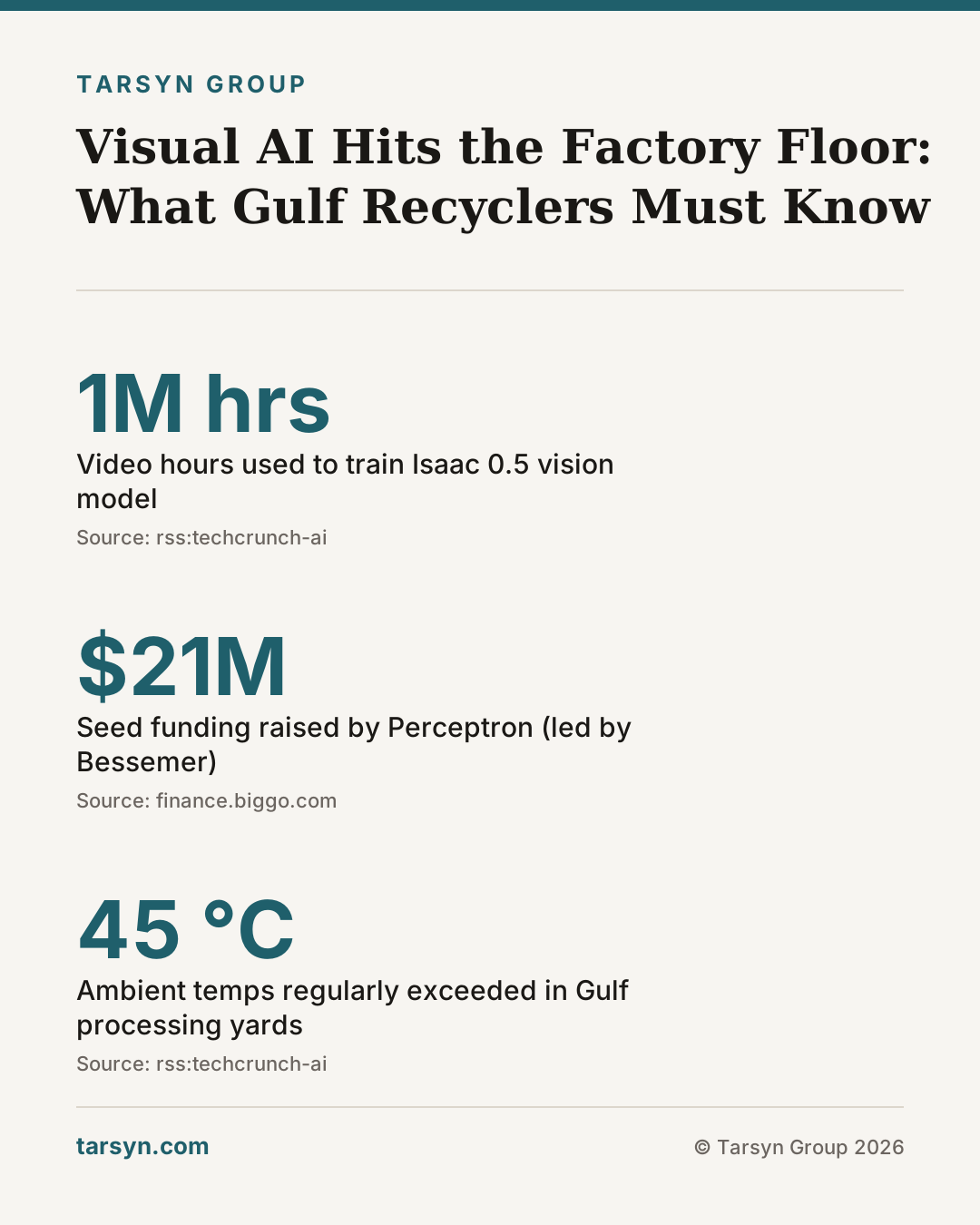
!Visual AI Hits the Factory Floor: What Gulf Recyclers Must Know — the numbers at a glance
- Ex-Meta scientists want to bring visual AI to the factory floor — rss:techcrunch-ai
- Ex-Meta Researchers Unveil Open-Weight Vision Model for Industrial Robots — BigGo Finance — finance.biggo.com