Alat's $100B Bet: The Recycled Materials Gap

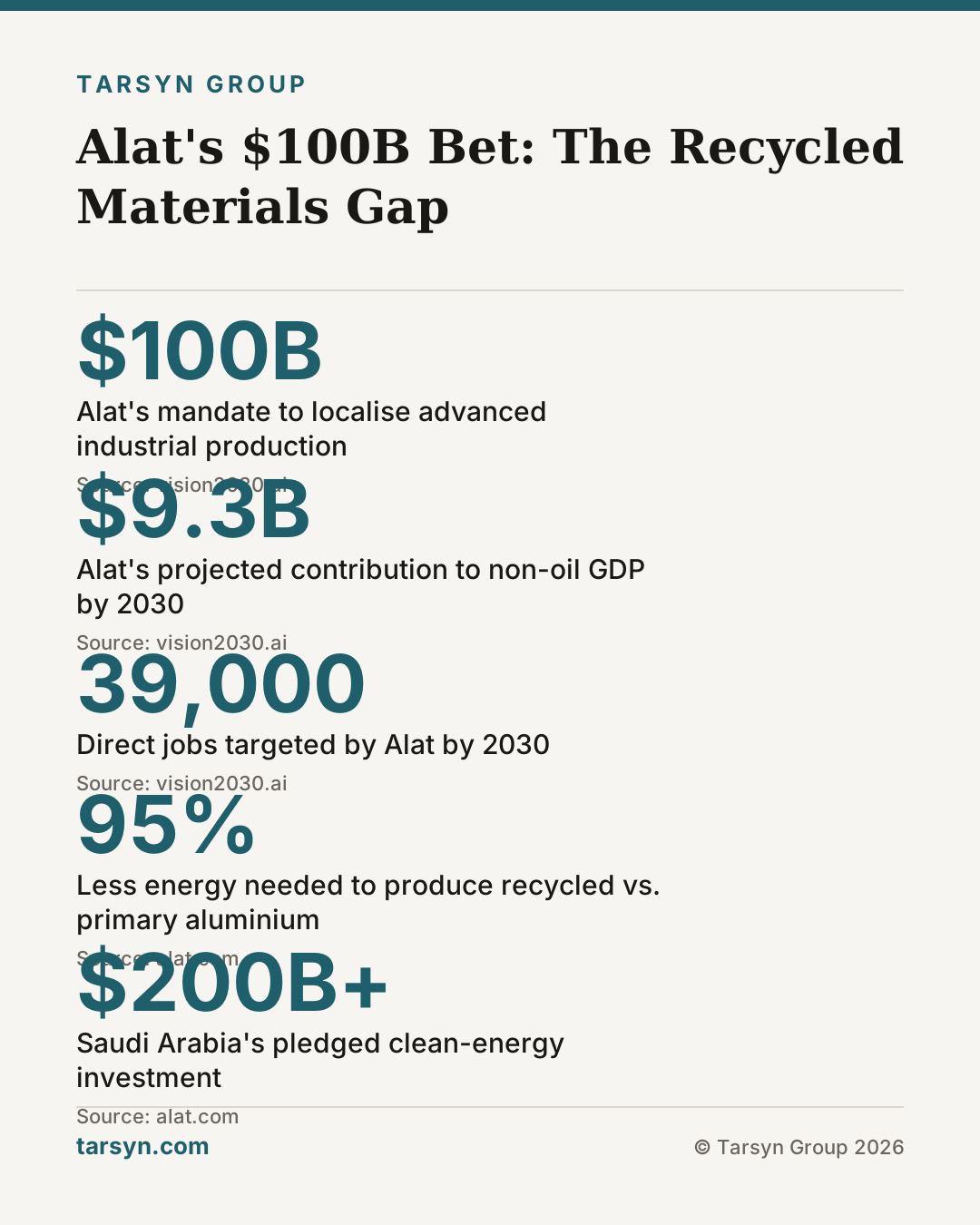
- Alat is a PIF-owned $100B sustainable manufacturing company targeting 39,000 direct jobs and ~$9.3B in non-oil GDP by 2030.
- Saudi Arabia has pledged 50% renewable power by 2030 and over $200B in clean energy investment — Alat's green credentials depend on inputs matching that ambition.
- GCC recycling infrastructure cannot currently supply the volume of secondary metals and materials a program of Alat's scale requires.
- Scrap traders and industrial recyclers who formalise supply agreements before Alat's procurement chain solidifies will hold the strongest negotiating position.
A $100 billion sustainable manufacturing program is taking shape in Saudi Arabia, and the conversation in most boardrooms stops at the headline number. It shouldn't. The harder question — where do the raw materials come from, and how green are they? — is the one that will determine whether Alat delivers on its sustainability mandate or quietly walks it back.
What Alat actually is, and why the scale matters
Alat is a Public Investment Fund subsidiary, chaired personally by Crown Prince Mohammed bin Salman, and launched in February 2024 with a $100 billion mandate to localise advanced industrial production 1. Its target sectors span electronics, robotics, smart buildings, smart appliances, electrification and next-generation infrastructure — not a single factory but an industrial platform built to serve Saudi Arabia's domestic AI, construction and automation boom 1.
The ambition is concrete: 39,000 direct jobs and approximately $9.3 billion contributed to non-oil GDP by 2030 1. The Lenovo PC and server factory — a $2 billion joint venture beginning production in 2026 — is the first major anchor, alongside partnerships with Carrier, SoftBank, Dahua, TK Elevator and Tahakom 1. This is not a concept paper. Procurement is already moving.
The "sustainable" in Alat's name carries weight on paper. Saudi Arabia has committed to sourcing 50% of its power from renewable energy by 2030, is targeting 58.7 GW of solar and wind capacity, and has pledged more than $200 billion in clean-energy investment 2. Alat explicitly positions itself as building an industrial hub that is "inherently sustainable from the very beginning," deploying AI and Industry 4.0 to drive sustainability across production and supply chains 2.
That framing sets a standard. And a standard that covers the supply chain has direct implications for what goes into Alat's factories, not just what powers them.
Sustainable manufacturing requires sustainable inputs
Green electricity at the point of production is the easy part. The harder discipline is embodied carbon — the carbon cost locked into raw materials before they arrive on the factory floor. For electronics, robotics and electrification equipment, the primary inputs are metals: aluminium, copper, steel, rare-earth-adjacent alloys. Mining and refining these from virgin ore is energy-intensive in ways that renewable power at one facility cannot offset.
Secondary metals — produced by melting and reprocessing scrap — carry a fraction of the embodied carbon of primary equivalents. Recycled aluminium, for instance, requires roughly 95% less energy to produce than primary aluminium smelted from bauxite. For a program positioning itself as a global benchmark in sustainable manufacturing, the credibility of that claim rests on what enters the supply chain, not just how the factory floor is powered.
Global partners, ESG-focused financiers and international customers will apply exactly this scrutiny. IFRS S1 and S2 disclosure standards are already pushing GCC industrials toward scope 3 emissions accounting — meaning the carbon embedded in purchased materials will appear on the balance sheet of every supplier in Alat's ecosystem. For more on that shift, see IFRS S1 & S2: What GCC Industrials Must Do Now.
The practical conclusion is unavoidable: a credible sustainable manufacturing program at Alat's scale needs a credible domestic supply of recycled metals and secondary raw materials.
The recycled-materials gap Saudi Arabia still needs to close
The gap is structural. GCC collection systems for post-industrial and post-consumer scrap are fragmented. Formal scrap trading — the kind with documented grades, certified weights, and auditable chain of custody — is thin relative to the volumes that a program of Alat's scale will eventually require. Secondary processing capacity for aluminium and copper within the Kingdom is limited. Most large industrial users currently import primary material or source scrap from overseas, which adds cost, extends lead times, and exports the carbon benefit.
This is not an unfamiliar problem for the region. The GCC's $20.7 billion infrastructure wave is creating a parallel demand surge for secondary materials — demand the domestic recycling sector is equally unprepared to meet at scale. The dynamics there closely mirror Alat's situation; see GCC's $20.7bn Infrastructure Wave and the Secondary Materials Play.
The upstream challenge compounds further when packaging and traded goods enter the picture. Regulatory pressure on secondary materials — from frameworks like Europe's PPWR — is already tightening global feedstock availability and redirecting recycled material toward regulated markets. Gulf traders feel that squeeze directly, as detailed in PPWR Tightens: What Gulf Traders Must Know Now.
For Alat specifically, the risk is a credibility gap: a program that carries the word "sustainable" at its core but sources virgin primary metals because no domestic recycled alternative exists at the required grade and volume. That gap is a procurement problem before it becomes a public relations one.
Where the supply-chain opportunity sits for traders and recyclers
The opportunity is structural and time-limited. Alat's supply chain has not yet crystallised. Long-term supplier agreements, material specifications, and preferred vendor lists are in early formation. The window to enter on favourable terms — with pricing power and preferred-supplier status — is now, not after the Lenovo plant is in full production and procurement teams have defaulted to established international suppliers.
For a GCC scrap trader or secondary-metals recycler, the positioning requirements are specific:
1. Grade documentation. Alat's sustainability mandate means informal, undocumented scrap supply will not clear the bar. Material grades need to be formally classified, third-party verified, and consistent batch to batch. 2. Volume certainty. Manufacturing procurement buys on forward commitments. Operators who can guarantee quarterly tonnage — not spot lots — are the ones who get on approved vendor lists. 3. Chain of custody. As scope 3 reporting tightens, buyers need to trace exactly where recycled material originated. Operators who build auditable custody records now will hold a material advantage over those who do not. 4. Proximity logistics. Domestic sourcing reduces lead times and avoids import duties. A local recycler who can deliver consistent grade within the Kingdom serves Alat's supply chain better than an international shipper offering equivalent material. 5. Technology readiness. Alat's own operations will lean on AI and Industry 4.0 tooling 2. Suppliers whose operations are similarly data-enabled — real-time inventory, digital quality records, automated sorting — will integrate more cleanly. Visual AI in recycling operations is already proving its value on the factory floor; see Visual AI Hits the Factory Floor — What It Means for Gulf Recyclers.
The US tariff environment in 2025 has added a further dimension: disrupted global scrap flows have created regional price dislocations that a well-positioned GCC trader can exploit. The dynamics are mapped in What US Double-Digit Tariffs Mean for GCC Recycling Trade.
Tarsyn Group's view: act on infrastructure, not just ambition
Alat is genuinely significant — not as a press release but as a procurement engine that will pull billions of dollars of materials through Saudi supply chains over the next decade. The mistake is to treat it as a story about vision and wait for the opportunity to become obvious. By then, it won't be an opportunity; it'll be a competitive market with established players.
The operators who will capture Alat's recycled-materials demand are the ones investing now in the boring prerequisites: certified processing capacity, documented grade systems, logistics contracts, and sustainability reporting that satisfies scope 3 scrutiny before buyers ask for it.
Ambition without infrastructure is a marketing exercise. Saudi Arabia has shown it can mobilise capital at speed — more than $200 billion committed to clean energy alone 2. The recycling and secondary-materials sector needs to mobilise with equal urgency, or it will watch that procurement flow offshore to suppliers who were ready.
For GCC operators looking to assess where they sit in this emerging supply picture — and what infrastructure investments make commercial sense before Alat's sourcing decisions lock in — talk to Tarsyn Group about sustainability operations. The time to map that position is before the contracts are written, not after.
The sustainable cost reduction framework for Saudi industrial operators applies directly here: the operators who align cost efficiency with recycled input procurement will serve Alat's mandate better than those chasing the lowest spot price on virgin material. That alignment is both the commercial opportunity and the competitive moat.
!Alat's $100B Bet: The Recycled Materials Gap — the numbers at a glance