Saudi Manufacturing Grows — So Does Its E-Waste Problem

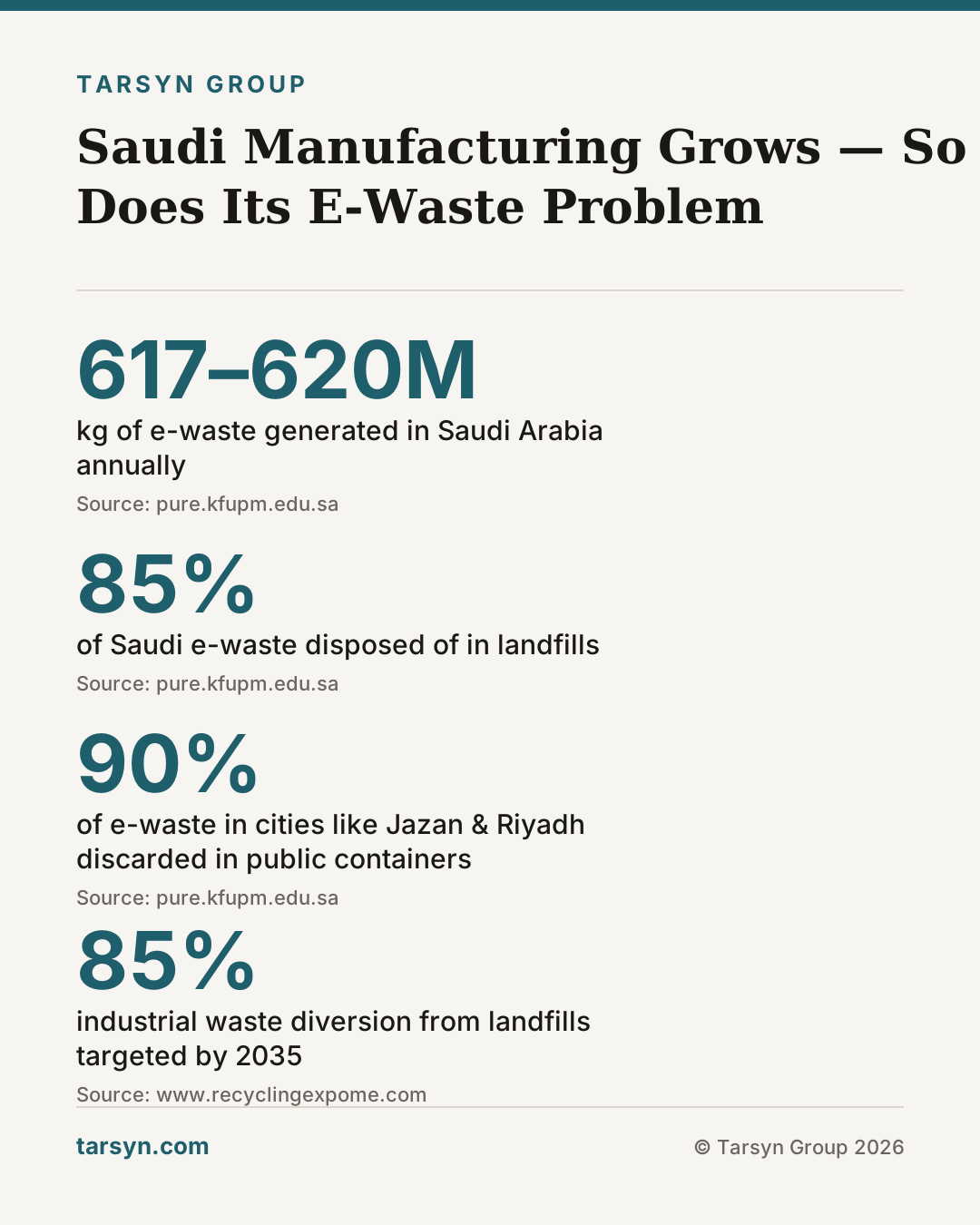
- Saudi Arabia generates approximately 617–620 million kg of e-waste annually, with 85% currently landfilled — a resource and liability problem that local manufacturing will compound.
- Vision 2030 targets diverting 85% of industrial waste from landfills by 2035, but EPR (extended producer responsibility) frameworks for electronics remain underdeveloped.
- Saudi Arabia's Waste Management System, issued in 2021, creates the licensing architecture for recycling — but enforcement and industrial-scale collection infrastructure lag far behind policy intent.
- Every device assembled locally under industrial localization programmes creates an end-of-life obligation; without closed-loop infrastructure scaled in parallel, the Kingdom risks trading import dependency for landfill dependency.
Lenovo shipped its first Saudi-assembled laptop in 2025 — a tangible milestone for Vision 2030's industrial localization agenda and a genuine feat of supply-chain diplomacy. The headline is real. But every device that rolls off a Saudi line carries an obligation that trails it by three to seven years: what happens when it stops working? The GCC's answer to that question is, at the moment, mostly "landfill."
Saudi Arabia Is Building Its Own Factories — But Who Handles the Waste?
Industrial localization is not just an assembly question. It is a materials-flow question. A laptop plant generates production scrap — metals, plastics, circuit-board offcuts — before a single unit ships. Once units reach consumers, they enter a product-lifetime clock. When that clock expires, the materials inside them — copper, aluminium, rare earths, lead — either re-enter productive use or they disappear into a dump.
Saudi Arabia currently generates approximately 617–620 million kg of e-waste annually, and 85% of it is disposed of in landfills 2. That is not a recycling system with gaps. That is a recycling system that is largely absent at industrial scale. Adding domestic electronics production to this picture — without simultaneously building the collection, sorting, and processing infrastructure to close the loop — compounds a problem that is already quantifiably severe.
The geography of generation matters too. As of 2019, Makkah, Riyadh, and the Eastern Province were the Kingdom's three largest e-waste sources 2. These are also the cities attracting the densest manufacturing investment under Vision 2030. Concentration of production and concentration of end-of-life volumes in the same urban corridors should be a planning signal, not an afterthought.
What Industrial Localization Actually Generates: Materials, Scrap, and End-of-Life Obligations
A useful way to think about localization economics: every new factory is also a future waste-stream commitment. Electronics assembly generates several distinct material obligations across its lifecycle:
1. Production scrap — metal stamping offcuts, PCB reject rates, packaging waste. Generated immediately, on-site, every shift. 2. Warranty returns and factory seconds — devices that fail quality control or come back within warranty windows. High material value; requires secure, tracked disassembly. 3. Consumer end-of-life units — the main volume, arriving in waves 3–7 years after sales peaks. This is where the 85%-to-landfill figure originates 2. 4. Industrial consumables — soldering materials, chemical baths, protective films. Hazardous waste streams that require specialist handling regardless of product volume.
None of these streams is self-managing. Each requires licensed operators, tracked logistics, and processing capacity. Saudi Arabia's Waste Management System, issued in August 2021, creates the legal architecture: licensing frameworks for collection, sorting, treatment, and recycling, including specific provisions for electronic waste 1. But a licensing framework is not a functioning collection network. The physical infrastructure — buy-back kiosks, urban collection points, certified dismantling facilities, downstream smelters — must be built and commercially sustained. That work is largely ahead of the Kingdom, not behind it.
How Vision 2030's Manufacturing Push Compares to Its Recycling Readiness
Vision 2030 sets an explicit target: divert 85% of industrial waste from landfills by 2035 3. That is an ambitious commitment, and it sits in the same strategy document as the industrial localization targets driving investments like the Lenovo plant. The problem is sequencing. Manufacturing capacity can be stood up in 18–36 months with the right investment and political will. Recycling infrastructure — especially for electronics — typically takes a decade to mature: regulatory design, market development, operator licensing, consumer behaviour change, and the economics of secondary materials all have to align.
The gap between where the Kingdom's recycling ecosystem sits today and where it needs to be by 2035 to meet its own stated targets is not a political failure — it is a planning gap that can be closed if addressed with the same urgency as the manufacturing agenda. Research from King Fahd University of Petroleum and Minerals identifies the absence of extended producer responsibility (EPR) frameworks as a central structural weakness 2. EPR — which makes manufacturers financially accountable for end-of-life management — is the mechanism most likely to align production incentives with recycling investment. Without it, the cost of recovery falls on municipalities and the environment rather than the supply chain that created the obligation.
This is not a uniquely Saudi problem. The GCC as a whole has moved faster on production ambition than on materials recovery — a pattern examined in depth in our piece on GCC's $20.7bn Infrastructure Wave and the Secondary Materials Play. But Saudi Arabia's scale, and the pace of its localization drive, makes the stakes higher here than anywhere else in the region.
Four Gaps Between GCC Production Ambition and Recycling Infrastructure Today
The structural mismatches are specific and operational, not abstract:
1. EPR is absent for electronics. No framework currently makes Saudi-registered manufacturers or importers responsible for the cost of recovering their products. Localizing production without EPR means the Kingdom absorbs end-of-life costs that the supply chain should carry 2.
2. Collection infrastructure is thin outside major cities. With 90% of e-waste in cities like Jazan and Riyadh discarded in public containers 2, there is no differentiated collection system capturing device-level materials. Urban concentration helps — but only if infrastructure follows it.
3. Secondary materials markets are shallow. Recycled copper, aluminium, and plastics recovered from e-waste need buyers. GCC industrial buyers still default to virgin material imports. Until secondary materials are price-competitive and quality-certified, the economics of formal recycling remain marginal. Developments like visual AI on the factory floor are beginning to change material-sorting economics — but adoption is early.
4. The 2035 diversion target requires sustained annual progress from a low base. Vision 2030's 85% industrial waste diversion goal 3 demands that new facilities — including electronics plants — are designed and licensed with end-of-life handling built into their operating models from day one, not retrofitted later.
Tarsyn's View: Localization Without Loop Closure Is an Unfinished Strategy
The Lenovo announcement is not the problem. Local manufacturing is genuinely better for Saudi industrial development, employment, and supply-chain resilience than perpetual import dependence. The issue is that the industrial policy conversation and the recycling infrastructure conversation are happening in separate rooms.
A laptop assembled in Riyadh should, by design, have its end-of-life pathway mapped at the point of production licence approval. That means: an EPR levy or equivalent mechanism attached to units sold domestically; certified take-back or collection partners identified in the supply chain plan; and downstream processing capacity — either in-Kingdom or contractually secured across the GCC — for the material streams the device contains.
This is not regulatory maximalism. It is basic materials accounting. The same logic applies to every industrial localization project in the Kingdom — automotive components, white goods, solar panels, defence equipment. Each creates a materials obligation. Each obligation, if unmanaged, becomes a cost that the state, the environment, or future operators absorb.
For GCC operators already navigating tightening global frameworks — from the EU's PPWR packaging rules to shifting commodity flows — the direction of travel is clear. Materials recovery is becoming a compliance requirement, a procurement condition, and a margin lever simultaneously. Operators who build recycling and secondary-materials capability now, before regulation forces it, will have both a cost advantage and a contract advantage over those who wait.
The Kingdom is not trading one dependency for another — not yet. But the window to design that outcome out of the system is while the factories are being built, not after they have been running for a decade.
Talk to Tarsyn Group about building circular economy operations into your industrial strategy before end-of-life obligations become balance-sheet liabilities.
!Saudi Manufacturing Grows — So Does Its E-Waste Problem — the numbers at a glance
- Saudi Waste Management System 2026- Step by Step — sustainableresourcesoffice.sa
- E-waste management in Saudi Arabia: Policy challenges, environmental hazards, and sustainable solutions - King Fahd University of Pet — pure.kfupm.edu.sa
- Vision 2030 and Saudi Arabia’s Circular Economy Transformation — www.recyclingexpome.com