AI's Resource Hunger Is a Circular Economy Wake-Up Call
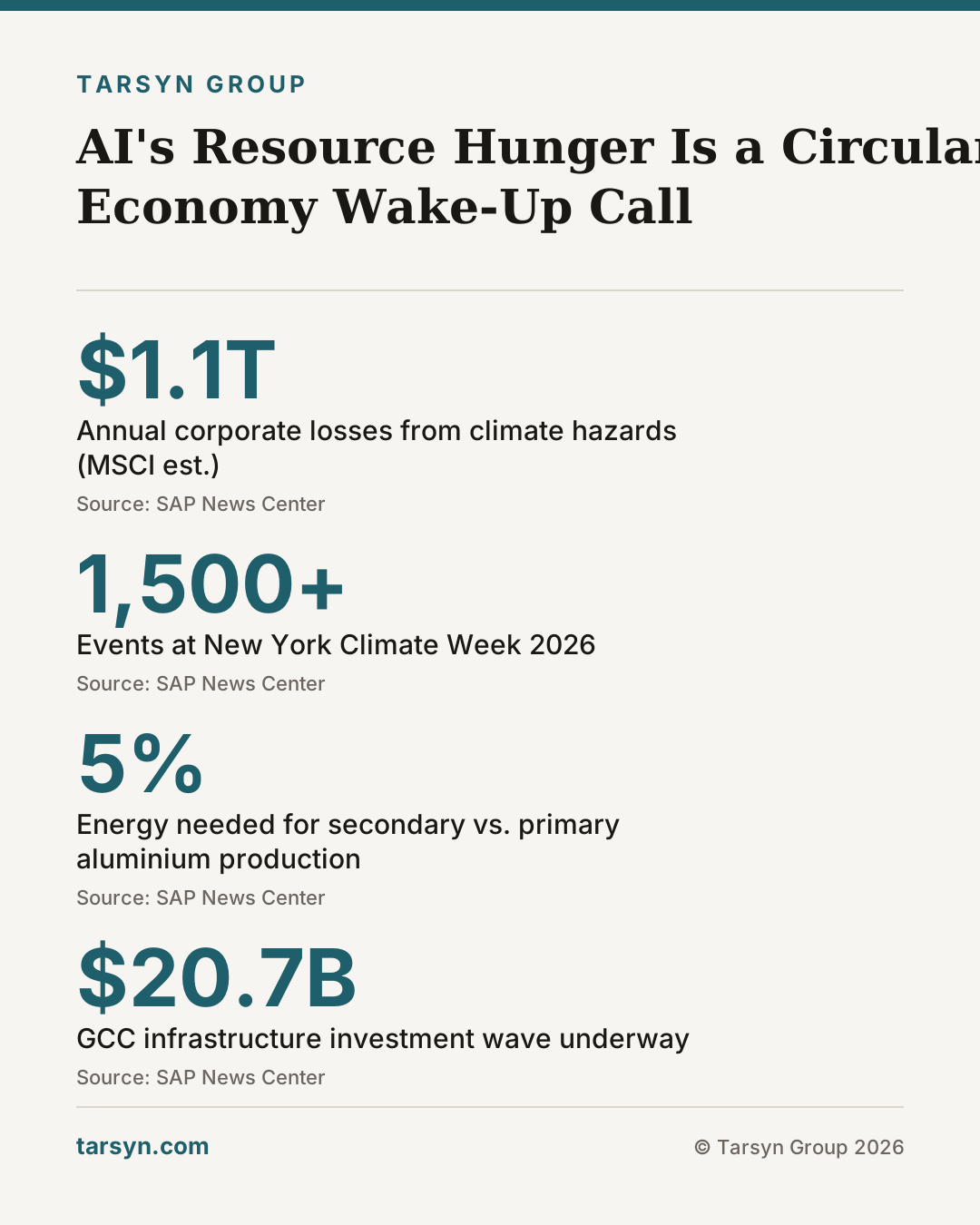
- New York Climate Week 2026 — over 1,500 events — confirmed AI's resource consumption has moved from ESG footnote to boardroom capital-allocation pressure.
- MSCI estimates corporate business-interruption losses from climate hazards exceed $1.1 trillion a year, most never appearing on a balance sheet — a structural blind spot for operators ignoring physical risk.
- Secondary metal, rubber, and industrial-material flows reduce virgin-resource demand created by AI-driven manufacturing expansion, making circular infrastructure a direct cost hedge.
- GCC operators who build circular-economy supply chains now will be better positioned ahead of tightening extended-producer-responsibility and sustainability-disclosure rules already moving through global regulators.
By the final Thursday of New York Climate Week 2026, the argument had been made so many times across so many panels that it stopped feeling like a forecast. AI's consumption of energy and raw materials is not a future problem. It is a present-tense cost sitting inside every capital plan that touches manufacturing, logistics, or data infrastructure.
The week — hailed as the biggest Climate Week yet, with more than 1,500 events running alongside the UN General Assembly [^1] — marked a clear shift in register. Delegates did not arrive to set new pledges. They arrived to work out how to deliver on existing ones while absorbing three simultaneous shocks: an energy price shock, a summer of climate disasters, and a fast-growing confrontation with what AI actually requires to run. [^1]
For Gulf industrial operators, the signal is precise. The same circular-economy infrastructure that recovers metals, rubber, and industrial materials from waste streams is the infrastructure that offsets the virgin-resource demand that AI-driven manufacturing expansion will intensify. Building that infrastructure now is not an ESG commitment. It is a procurement strategy.
Why AI's Resource Appetite Has Moved into the Boardroom
The consensus at Climate Week 2026 was not that AI is bad for the planet. It was that AI's resource requirements have become a capital-allocation variable that CFOs can no longer set aside for the sustainability team to handle. [^1]
The framing was direct: sustainability now sits inside the numbers that decide whether companies grow, stall, or get stopped. [^2] That is a different conversation from carbon reporting. It means that a board approving a data centre expansion or a new manufacturing line is, implicitly, also approving a raw-material procurement position, an energy contract, and an exposure to commodity price movements.
The physical-risk dimension compounds this. An MSCI analysis cited during the week estimates corporate business-interruption losses from climate hazards at more than $1.1 trillion a year — most of which never appears as a line on a balance sheet. [^2] Operators who treat resource and climate risk as a reporting exercise rather than a decision-making input are, by that measure, flying with an instrument panel that is missing most of its gauges.
The Raw-Material Cost Hiding Inside Every Data Centre Expansion
A data centre is a metal-intensive structure before it processes a single query. Copper for power wiring and busbars, aluminium for cooling systems and cable trays, steel for the rack and building frame, and a suite of specialist metals in the servers themselves — nickel, cobalt, and rare-earth elements in smaller but price-sensitive quantities. When AI model complexity increases and inference workloads scale, facilities multiply and the draws compound.
Manufacturing expansion linked to AI automation — robotics, vision systems, edge-computing infrastructure on the factory floor — carries identical material requirements. The growth of humanoid robots and automated industrial systems in Gulf warehouses and factories adds another layer of hardware demand on top of the data centre footprint.
Operators who source these materials exclusively from primary commodity markets are exposed on two fronts simultaneously: the price volatility that accompanies demand surges, and the procurement lead times that stretch when multiple industries compete for the same refined output. Neither risk is hypothetical in 2026. Both are visible on any procurement dashboard tracking copper or aluminium futures.
How Circular Supply Chains Absorb the Pressure
A functional circular economy operates as a secondary commodity market. End-of-life industrial equipment, manufacturing scrap, packaging waste, and decommissioned infrastructure yield metals, polymers, and rubber that re-enter production without the energy intensity or geopolitical exposure of primary extraction.
For a Gulf industrial operator, the practical implication is straightforward. Secondary copper recovered from cable scrap or electrical equipment runs at a fraction of the carbon intensity of smelted primary copper, and its price, while correlated with LME copper, is structurally discounted. Secondary aluminium requires roughly 5% of the energy needed to produce primary aluminium from bauxite — a number that matters when regional energy costs are rising and when IFRS S1 and S2 disclosure requirements are making Scope 2 and Scope 3 emissions visible on financial statements.
Rubber is a less-discussed but equally concrete example. Industrial operations in the GCC generate substantial end-of-life tyre and rubber-component waste from logistics fleets, port equipment, and heavy machinery. Devulcanised and reclaimed rubber re-enters production as a secondary raw material for conveyor belting, seals, and flooring — reducing both disposal costs and virgin-polymer purchases. Saudi Arabia's local manufacturing growth is already surfacing this gap at scale: production capacity is rising, but the recycling infrastructure to close the material loop has not kept pace.
Extended-producer-responsibility frameworks and packaging regulations — already tightening in the EU and affecting GCC exporters through PPWR compliance requirements — will accelerate demand for certified secondary materials. The operators with established recovery and processing capacity will meet that demand profitably. Those without it will pay a compliance premium on top of an already elevated primary-materials bill.
What GCC Operators Must Do Before the Next Regulatory Tightening
Climate Week 2026's working sessions produced a consistent observation: the gap between reporting risk and deciding on it is where most companies are currently stuck. [^2] The same gap exists on the materials side. Operators know, in the abstract, that secondary-material sourcing is advisable. Few have built it into procurement policy at a level that influences capital allocation.
The preparation checklist for a Gulf industrial operator in Q4 2026 is concrete:
1. Baseline the waste stream. Audit current industrial waste by material type and weight. Identify which streams — ferrous scrap, non-ferrous metals, rubber, industrial polymers — are being landfilled or exported as low-value bulk, and quantify the recovery gap in tonnes and USD/tonne. 2. Map AI-linked input exposure. For each major capital project involving AI-adjacent technology — automation, digital infrastructure, robotics — identify the metals and materials required and cross-reference against current supplier concentration. 3. Price the secondary alternative. For the top three inputs by value, establish a secondary-material price benchmark and model the cost differential over a three-year procurement horizon. In most cases, the savings on copper and aluminium alone justify the supply-chain investment. 4. Engage regulatory timelines. Map which extended-producer-responsibility rules apply to the products or materials the business sells into, exports through, or sources from regulated markets. Build compliance dates into capital-planning cycles rather than treating them as a legal department issue. 5. Build circular procurement into capex governance. Require that any new facility or expansion project above a defined capital threshold includes a secondary-material sourcing assessment as a standard approval gate.
Tarsyn Group's advisory practice works with Gulf industrial operators on exactly this sequence — from waste-stream baselining through to secondary-material procurement strategy and regulatory positioning.
Tarsyn Group's View: Secondary Materials Are the Strategic Hedge Gulf Industry Needs
The GCC faces a specific version of a global tension. The region is accelerating industrial capacity — Vision 2030 programmes, Alat's manufacturing ambitions, and a$20.7 billion infrastructure wave — at the same moment that AI is driving global demand for the same metals and energy those programmes require. You cannot decarbonize an industrial base and scale AI-adjacent manufacturing simultaneously without resolving the raw-material equation. There is no version of this that works on primary supply alone.
Secondary material flows are the resolution. They are not a sustainability gesture. They are a procurement hedge against commodity price shocks, a compliance position ahead of tightening regulation, and an operational margin lever that compounds as energy prices remain elevated.
The Climate Week 2026 sessions made one structural shift audible: sustainability is no longer the department that reports on what operations does. It is a factor inside operations itself — inside procurement, inside logistics, inside capital allocation. [^1] For Gulf industrial operators, that shift has a specific implication: the companies that treat circular-economy infrastructure as a core operational investment, not a reporting line, will have lower input costs, cleaner compliance positions, and more resilient supply chains than those that do not.
The secondary materials market in the GCC is underdeveloped relative to the industrial scale the region is building toward. That is the gap. It is also, for operators who move early, the opportunity.
[^1]: AI's Future Runs Through Sustainability — SAP News Center [^2]: AI's Future Runs Through Sustainability — SAP News Center [^3]: 8 Takeaways from Climate Week New York 2026 — Think Parallax
!AI's Resource Hunger Is a Circular Economy Wake-Up Call — the numbers at a glance