Virtual Power Plants: The Waste-to-Energy Case for Gulf Industry

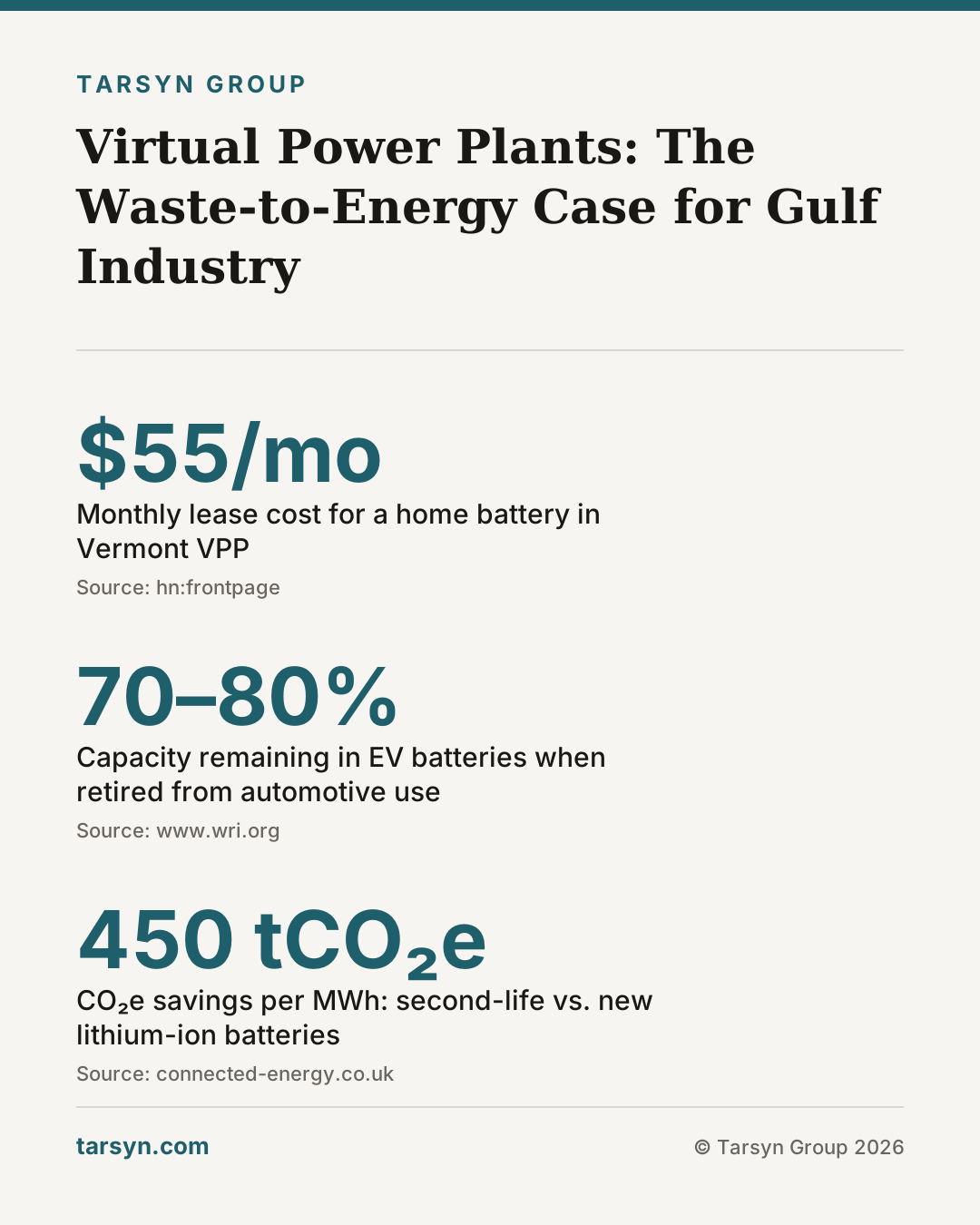
- Vermont's Green Mountain Power installed home batteries at $55/month per household, making distributed storage its largest single power source during peak demand periods.
- Retired EV batteries retain 70–80% of original capacity at end of automotive life, making them viable grid-storage feedstock at a fraction of new-cell cost.
- Second-life battery systems save approximately 450 tonnes of CO₂e per MWh installed compared with new lithium-ion systems, according to a Lancaster University study.
- Gulf manufacturers who establish battery take-back pipelines before 2027 will lock in below-market storage costs as Saudi and UAE grid modernisation drives demand higher.
Pollyanna Bladyka, a homeowner in rural Vermont, was about to buy a gas generator when an electrician told her about something cheaper: a leased home battery at $55 a month.1 She signed up. So did thousands of her neighbours. Together, those batteries now constitute Vermont's largest single power source during periods of peak grid stress — a distributed network that displaces centralised generation not through policy aspiration but through hard commercial arithmetic.1 For GCC industrial operators, the Vermont story is interesting. The lesson buried inside it is urgent.
What Vermont's Virtual Power Plant Actually Proved
Green Mountain Power (GMP), Vermont's largest utility, built its virtual power plant (VPP) by aggregating household battery installations across thousands of ordinary homes.1 During extreme weather events — Vermont has seen some of its worst storms in recorded history in recent decades — the network dispatches stored energy to stabilise the grid without spinning up new fossil generation.1
The economics are blunt. Participants pay a flat lease rate rather than the capital cost of ownership. The utility gains dispatchable capacity without building a plant. Both sides benefit from a system that stores energy off-peak and releases it on-peak — the same principle that industrial operators have applied to water and compressed air for decades.2 A commenter in one technical forum described the mechanics plainly: the utility pre-charges batteries before a peak event, then runs homes off battery during the event, sometimes returning power to the grid at a contracted rate.2
What Vermont proved is not that home batteries are charming. It proved that distributed storage is commercially real, that aggregation works at scale, and that the cheapest path to grid resilience is often not a new power station but a coordinated network of assets that already exist inside buildings.
Why Distributed Storage Is a Waste-to-Value Story, Not Just a Grid Story
The Vermont VPP is presented as a grid-stability innovation. It is also — viewed from a supply-chain perspective — a waste-to-value operation. The batteries in those homes are manufactured assets with finite useful lives. When they degrade below utility thresholds, they become a cost problem: disposal, compliance, storage.
The circular economy reframes that problem. End-of-life batteries from electric vehicles present the same opportunity at industrial scale. Most EV batteries are retired with 70–80% of their original capacity still intact.3 They no longer meet automotive requirements — range demands full charging performance — but stationary grid storage does not need that. A battery that can hold 75% of its original charge is perfectly viable for peak-shaving, demand-response, and emergency backup.4
Connected Energy, a UK-based operator that builds storage systems from second-life EV packs, demonstrated the carbon arithmetic clearly: a Lancaster University study found approximately 450 tonnes of CO₂e savings per MWh of second-life system installed, compared with a system using new lithium-ion batteries.4 That saving reflects the full avoided manufacturing cycle — mining, cell production, pack assembly — of a new battery. For industrial operators who carry sustainability reporting obligations under frameworks like IFRS S1 and S2, this is not a soft benefit; it is a measurable emissions reduction that sits on the balance sheet.
The industrial logic is therefore: take a waste stream (end-of-life battery packs), process it through a refurbishment and repacking operation, and sell or deploy the output as a grid asset. That is waste to energy in its most literal form — not combustion, but reactivation.
Virtual power plants, when built on second-life battery feedstock, combine two value chains that are usually treated separately: distributed energy infrastructure and circular materials recovery. The VPP-circular economy integration reduces capital cost, extends asset life, and converts a disposal liability into a revenue-generating position.5
The Second-Life Battery Opportunity in the GCC
The Gulf has several structural conditions that make this opportunity more acute than in Europe or North America.
First, the EV fleet is growing fast across Saudi Arabia and the UAE, driven by government procurement targets, Vision 2030 mandates, and projects like Alat's manufacturing programme. That fleet will produce retired battery packs within a five-to-seven-year window. As covered in our analysis of Alat's $100B manufacturing bet, the downstream materials challenge is already visible at the planning stage.
Second, GCC grids face growing peak-demand stress. Air conditioning loads during summer months create demand spikes that utilities must provision for — typically with gas peaker plants running at low utilisation rates for much of the year. Distributed battery storage solves exactly this problem by shifting off-peak generation into on-peak dispatch, reducing the need for dedicated peaker capacity.
Third, Saudi local manufacturing is scaling without a matching recycling and end-of-life infrastructure. The gap between production volume and recovery capacity will widen unless operators build take-back systems now, ahead of regulatory pressure that is already arriving via global frameworks being adopted in the region.
Fourth, the cost of new lithium-ion batteries remains high relative to refurbished packs. Industrial operators who source second-life cells through their own take-back programmes — rather than buying new storage systems at market rate — capture a structural cost advantage that compounds over the life of the asset.
The combination is clear: rising supply of end-of-life packs, rising demand for grid storage, a price differential that favours refurbishment, and a regulatory environment moving toward mandatory battery stewardship. Operators who move now build the pipeline before the market prices it in.
Four Steps Gulf Industrial Operators Should Take Before 2027
Acting on this requires sequential, practical moves — not a strategy document.
1. Audit battery-containing assets in your fleet today. Forklifts, UPS systems, industrial vehicles, and grid-tied solar installations all carry battery packs approaching retirement. Knowing what you will have available in 24–36 months is the prerequisite for everything else. This audit feeds directly into the kind of sustainability operations assessment that Tarsyn Group supports.
2. Map EV fleet growth in your sector as a supply signal. Municipal fleets, logistics operators, and construction companies across the GCC are electrifying. Early relationships with fleet operators — structured as preferred take-back agreements — give you first access to the most valuable second-life feedstock before commodity traders enter the market.
3. Qualify a refurbishment partner capable of IEC-compliant cell testing and repacking. Not all end-of-life packs are suitable for second-life deployment without grading and repacking. A partner with capacity-testing capability can grade cells into storage-grade and recycle-grade streams, maximising recovery value while meeting safety standards required by utilities and grid operators.
4. Engage Saudi and UAE grid authorities on VPP tariff frameworks now. Grid modernisation procurement in both markets is accelerating. Operators who arrive at those conversations with demonstrated storage assets and a circular-supply model have a fundamentally different commercial position than those who show up later asking for a tariff. The GCC's $20.7bn infrastructure wave is moving fast enough that early positioning matters in quarters, not years.
Tarsyn Group's View: Circular Infrastructure Beats Stranded Assets
The Vermont story will be replicated across Gulf markets. The question is not whether distributed battery storage becomes a significant part of GCC grid infrastructure — the economics and the policy direction are both pointing that way. The question is who controls the feedstock supply chain when that transition accelerates.
Industrial operators who treat end-of-life batteries as a disposal cost will find themselves buying new storage at market rate and paying landfill fees on top. Those who treat spent packs as the raw material input to a circular energy infrastructure will have built, by the time grid modernisation procurement peaks, a captive supply of below-market storage capacity and a measurable emissions advantage for their sustainability reporting.
This is not an environmental argument dressed in commercial language. It is a straight cost-structure argument: second-life battery systems cost less to build, carry lower embodied carbon than new equivalents,4 and are fed by a supply stream that your competitors are currently discarding. Building a take-back and refurbishment pipeline is not a sustainability initiative — it is a capital efficiency decision.
The operators who move before 2027 will own the infrastructure. Those who wait will rent it, at whatever rate the market sets. We have seen this pattern in scrap metal, in packaging materials, and in industrial gases — as discussed in our piece on turning waste gases into chemicals. Circular economy early movers consistently outperform on input costs when commodity cycles tighten.
Battery feedstock is next. The supply is building. The grid demand is coming. Talk to Tarsyn Group about building the pipeline before the window closes.
!Virtual Power Plants: The Waste-to-Energy Case for Gulf Industry — the numbers at a glance
- Vermont replacing power plants with home batteries — hn:frontpage
- Vermont replacing power plants with home batteries (discussion) — Hacker News
- Second-Life Batteries Can Play a Vital Role in the Clean Energy Transition | World Resources Institute — www.wri.org
- Second Life Electric Vehicle Batteries | Connected Energy — connected-energy.co.uk
- Virtual Power Plants and the Circular Economy: Enhancing Grid Resilience and Power Decarbonization | EnergyOMNI 全能源 I Enera Media Ltd. 恩能新元傳 — www.energy-omni.com