Solar Beats Nuclear: The Circular Economy Reckoning
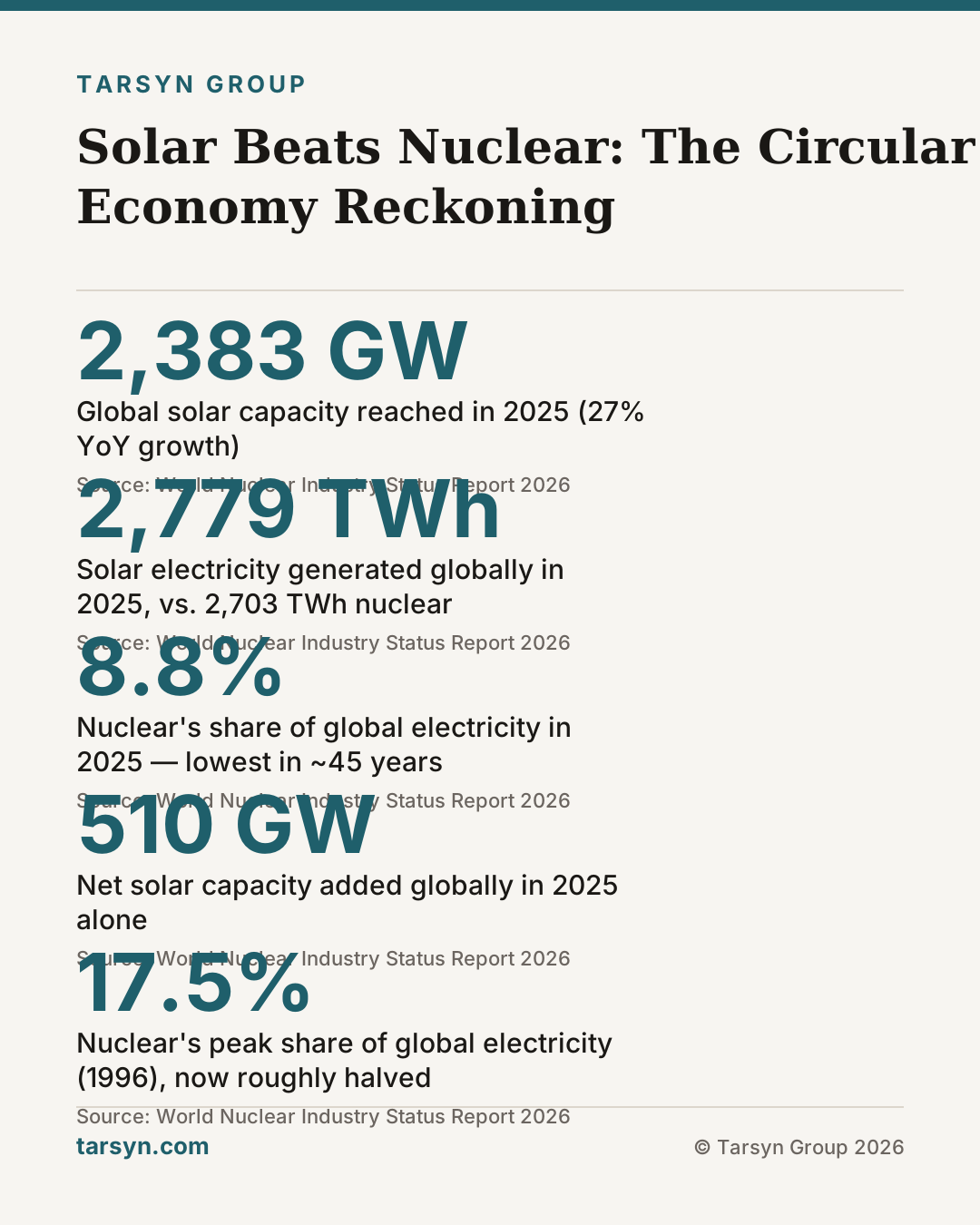
- Solar generated more electricity than nuclear globally across full-year 2025 — the first time this has happened, with solar capacity hitting 2,383 GW vs nuclear's 399.5 GW.
- Nuclear's share of global electricity fell to 8.8% in 2025, its lowest level in roughly four and a half decades.
- Global solar capacity grew 27% in 2025, adding 510 GW; nuclear added just 1.5 GW in the same period.
- End-of-life PV panels create four recoverable material streams — silicon, silver, aluminium, and copper — that will constitute a live secondary-materials market for GCC operators within this decade.
In April 2025, a quiet milestone landed in an industry status report with no fanfare from any government press office: for the first time in the history of electricity, solar panels generated more power in a single month than every nuclear reactor on earth combined. By the end of the year, the lead had held across all twelve months — making 2025 the first full calendar year in which solar outproduced nuclear globally.[^3] For Gulf industrial operators, the headline is not primarily about energy policy. It is about materials, logistics, and a circular economy obligation that is accumulating faster than most procurement teams realise.
Solar's historic overtake: what the numbers actually show
The World Nuclear Industry Status Report 2026 is the primary source for the milestone, and its figures are stark. Global solar capacity reached 2,383 GW in 2025 — a 27% year-on-year increase, representing 510 GW of net additions.[^3] Wind added a record 159 GW to reach 1,291 GW.[^4] Nuclear, by contrast, added just 1.5 GW of installed capacity, while operating capacity actually fell by 0.5 GW to 368.6 GW as retirements and extended outages offset new builds.[^5]
The generation numbers tell the same story. Nuclear plants produced approximately 2,703 TWh in 2025.[^3] Solar — which generated just 1,054 TWh in 2021 — had surged to approximately 2,779 TWh by 2025.[^2] Nuclear's share of global electricity slipped to 8.8% in 2025, its lowest level in roughly four and a half decades and about half its 1996 peak of 17.5%.[^3]
One technical objection always surfaces here: nuclear has a far higher capacity factor than solar, meaning its installed GW work harder per hour. That objection is now moot at the TWh level — solar has grown so rapidly in raw deployment that it has taken the lead on actual output, not just nameplate capacity.[^2] Grid-scale battery storage helped close the intermittency gap, with 104 GW and 257 GWh of storage connected globally in 2025 alone, more than three-quarters of all cumulative battery storage having come online between 2023 and 2025.[^4]
Why this milestone reshapes material demand for manufacturers
Every solar panel is a bill of materials: crystalline silicon wafers, silver paste for electrical contacts, an aluminium frame, copper wiring, and a glass-and-polymer encapsulant. At 510 GW of annual additions globally,[^5] the upstream demand for these commodities is already reshaping spot markets. Silver consumption by the PV sector has been a structural price driver for several years. Aluminium extrusion demand for panel frames is a significant industrial order in any country with a serious buildout.
The downstream consequence is less discussed but equally important. Those same materials must eventually come back out. A standard utility-scale panel has a design life of 25–30 years, but significant volumes installed in the early buildout years are already approaching end-of-life in pioneer markets — and GCC panels installed today will reach that threshold between 2050 and 2055 at the latest. The circular economy mathematics are straightforward: 2,383 GW of installed solar capacity globally[^4] will eventually become 2,383 GW worth of decommissioned modules. At an average panel weight of roughly 20–25 kg, the tonnage is measured in tens of millions.
The GCC solar surge and its recycling blind spot
The Gulf's own buildout is accelerating. National targets tied to Vision 2030 in Saudi Arabia, the UAE's Net Zero 2050 commitment, and Qatar's National Vision 2030 are translating into gigawatt-scale project pipelines that are already under construction or in late-stage procurement. The region's comparative advantages — land, solar irradiance, and capital — mean that the gap between GCC installed capacity and global leaders will narrow materially this decade.
What is not keeping pace is end-of-life infrastructure. There is currently no established regional framework for PV panel collection, material separation, or secondary-market routing in most GCC jurisdictions. Regulatory pressure will eventually provide the forcing function — the EU's Waste Electrical and Electronic Equipment Directive already classifies PV modules as regulated e-waste, and as trading partners tighten environmental standards, Gulf exporters will face compliance friction — but operators who wait for regulation to arrive will find themselves scrambling for processing capacity that does not yet exist. The parallel with what happened to Gulf operators when IFRS S1 and S2 landed without adequate preparation is instructive.
Related: the GCC's $20.7bn infrastructure wave is already driving demand for secondary materials — solar panel recycling is the next layer of that same opportunity.
Panel end-of-life: four material streams industrial operators should be tracking now
A decommissioned crystalline silicon PV panel yields four commercially recoverable streams. Operators with existing metals-trading or recycling infrastructure should treat each as a separate procurement and pricing question:
1. Silicon — the semiconductor wafer is the highest-value component by material purity. Recovered silicon can re-enter the electronics supply chain if separation is handled correctly, though the economics depend on achieving adequate grade. Currently, most panel recycling globally recovers silicon at lower value grades; technology to recover higher-purity material is advancing.
2. Silver — used in finger and busbar contacts, silver content per panel has been falling as manufacturers reduce material intensity, but the aggregate volume across millions of decommissioned panels remains commercially significant. Silver is already a commodity actively traded in GCC metals markets.
3. Aluminium — the panel frame is typically high-grade aluminium alloy, straightforward to separate and melt. This is the most established stream in early-stage panel recycling operations because the processing pathway mirrors existing scrap aluminium workflows. For operators already handling aluminium scrap, this is the lowest-barrier entry point.
4. Copper — present in wiring, junction boxes, and busbars. Copper recovery follows existing scrap processing logic and trades at well-understood spot prices. As diesel price volatility continues to pressure scrap metal logistics margins, getting collection economics right early matters.
The glass and polymer encapsulant are the harder streams — glass recycling is economically marginal unless scale is sufficient to justify dedicated cullet processing, and the polymer backsheet presents separation challenges. But operators who wait until these streams are economically obvious will be entering a market that early movers have already structured.
Tarsyn's view: act before the wave breaks
The solar-nuclear crossover is not, in itself, a circular economy story. It becomes one when you follow the material flows forward by 25 years. The GCC is currently in the deployment phase of a buildout that will create one of the region's largest future secondary-materials challenges — and opportunities — within a single working career's horizon.
Tarsyn Group's position is direct: the operators who will extract value from this transition are the ones building collection agreements, processing capability, and commodity trading relationships now, while panel volumes are low and infrastructure costs are manageable. The ones who wait for a visible mountain of decommissioned panels will find the processing economics crowded and the regulatory frameworks already written by others.
This is not a call for speculative capital allocation. It is a call for operational preparation: conducting a material-flow audit of your supply chain to identify where PV components already appear, establishing relationships with the project developers and EPC contractors whose panels will eventually require disposal, and mapping the commodity pricing dynamics for the four streams above against your existing trading desk. For operators with existing metals recycling or scrap trading infrastructure, the adjacency to PV recycling is close enough that the barrier is logistics and permitting, not technology.
The circular economy case for acting early on solar panel recycling is the same as it was for aluminium can recycling, for steel scrap, and for copper wire recovery: the material is valuable, the volume is predictable, and the operators who build the infrastructure before the wave breaks set the terms for everyone who follows. Solar's overtake of nuclear is the signal. The question is whether Gulf industrial operators read it as a headline or a planning input.
Talk to Tarsyn Group about your sustainability operations and circular economy readiness.
Also relevant: Saudi local manufacturing's growing recycling gap and what AI's resource demand means for circular economy operators.
!Solar Beats Nuclear: The Circular Economy Reckoning — the numbers at a glance