Diesel Shock and GCC Scrap Metal Logistics
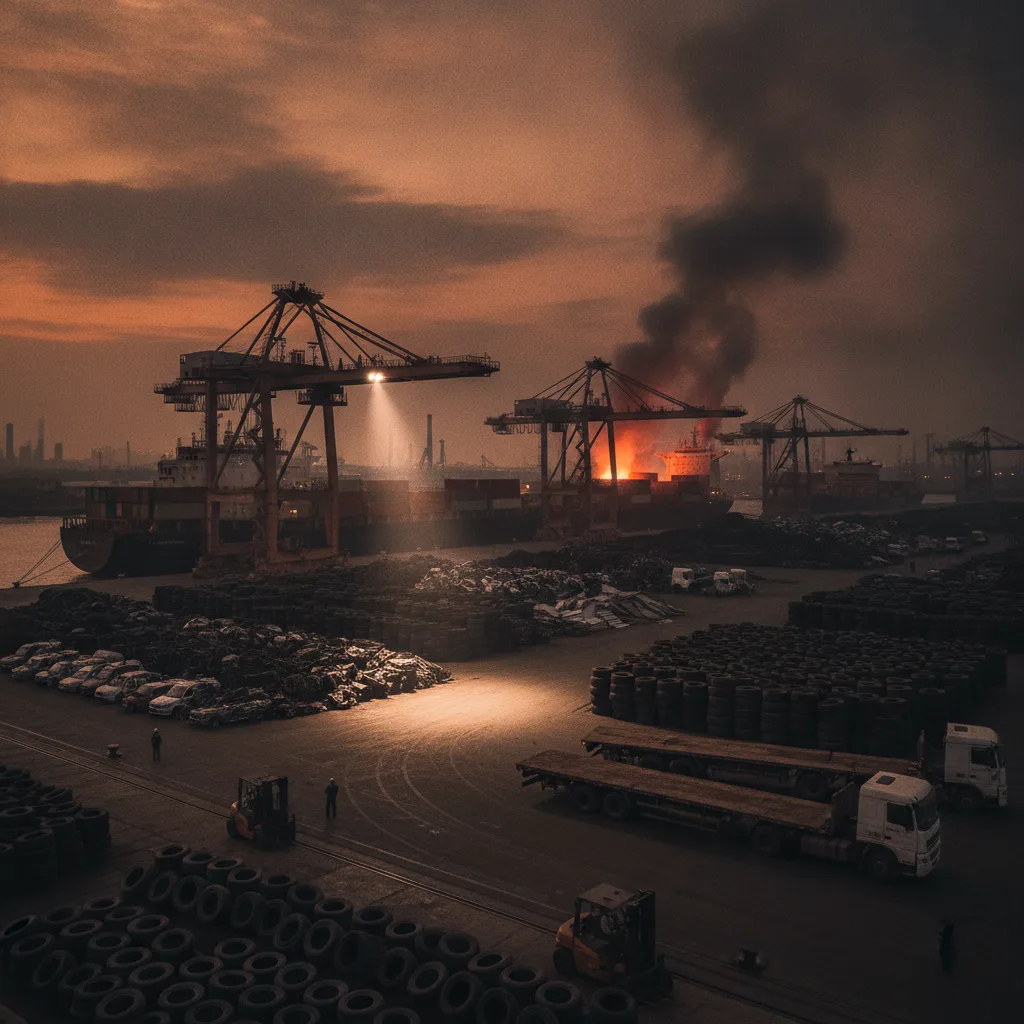
- 16 trucking companies filed for bankruptcy in a single 30-day window as diesel prices spiked — a direct warning signal for GCC road-dependent scrap collection networks.
- Fuel is typically one of the largest variable cost lines in scrap collection; even a modest per-litre increase compresses thin recycling margins to near zero on long haul routes.
- GCC scrap and secondary-materials logistics are disproportionately road-dependent, making regional operators more exposed to diesel volatility than port-heavy mature markets.
- Operators who renegotiate freight terms, redesign collection routes, and treat diesel as a tradeable exposure — not a fixed overhead — will retain collection economics when the next spike hits.
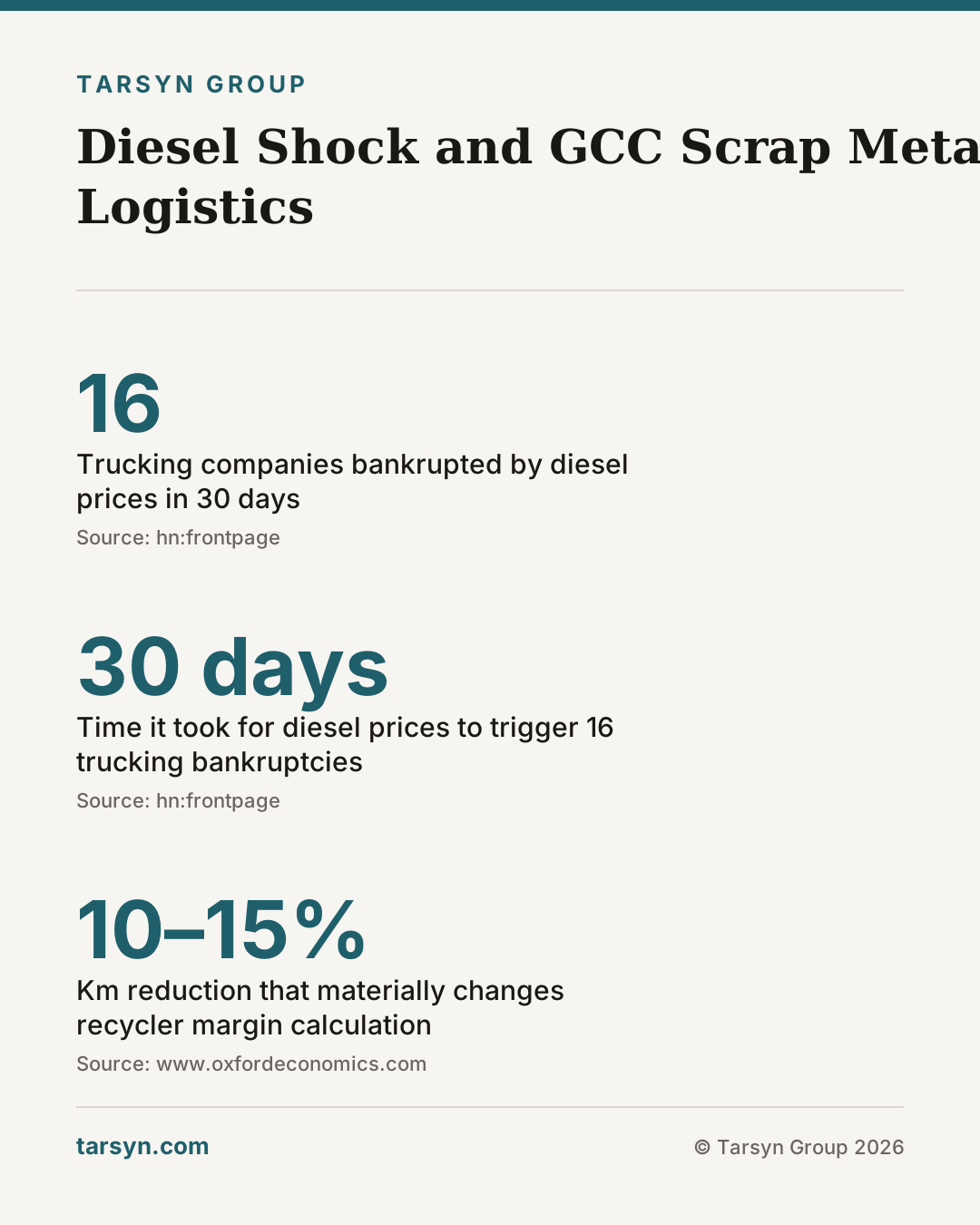
Thirty days. That is how long it took for diesel prices to push 16 trucking operators into bankruptcy — some running dozens of vehicles, others single-cab owner-operators — according to reporting tracked across multiple filings in late August and early September.1 The companies were US-based. The lesson is not.
For GCC scrap metal traders and secondary-materials operators, a trucking collapse on the other side of the world is not background noise. It is a stress test your own supply chain has not yet run — and the structural reasons you are exposed are hiding in plain sight on every collection manifest.
Why trucking failures abroad are a warning for GCC recyclers
The 16 bankruptcies were not caused by bad management or weak demand. They were caused by fuel costs crossing the threshold where revenue per kilometre could no longer cover the cost per kilometre, even at full load.1 That arithmetic is universal. What changes by geography is how much buffer operators have built in.
In the US, mature intermodal infrastructure — rail, coastal barge, dense hub-and-spoke routing — means freight can, in theory, shift modes when trucking gets expensive. The GCC has no equivalent depth. Scrap moves by truck from collection point to aggregator, from aggregator to shredder, and from shredder to port. Every stage is road-dependent. When diesel goes up, there is no lever to pull except to absorb the cost or cancel the collection run.
Geopolitical risk amplifies the base case. Regional conflict escalations have repeatedly introduced a measurable "war premium" into crude and refined product markets, including diesel, affecting transportation budgets for shippers across all sectors.3 Any scenario that tightens Strait of Hormuz traffic — even briefly — feeds through to domestic diesel costs faster than operators can renegotiate fixed freight contracts.5
How fuel costs eat recycling margins: the numbers that matter
Scrap metal trading runs on margins that are thin by design. The business model depends on volume, route efficiency, and buying scrap metal prices low enough relative to processed-metal sale prices to leave room for logistics. Fuel is not a minor line item inside that model — it is often the single largest variable cost.
Oxford Economics has documented how diesel supply crunches send cost pressure cascading through supply chains, hitting sectors with the least pricing power hardest.4 Recycling and secondary materials sit near the bottom of that pricing-power ranking. A scrap trader cannot pass a fuel surcharge to the generator who has already handed over the material; the only direction the cost can travel is into the trader's own margin.
The maths tighten further on long-haul collection routes — the kind that reach industrial zones, construction demolition sites, and port laydown areas spread across the GCC's large geography. A route that was marginally profitable at a lower diesel price becomes loss-making at a higher one without any change in scrap metal prices or metal recovery rates. Operators who have not modelled this threshold do not know how close they are to it.
For further context on how tariff and trade disruptions compound scrap economics, see our analysis of what US double-digit tariffs mean for GCC recycling trade.
The GCC's road-dependency problem in scrap logistics
GCC scrap and secondary-materials logistics are structurally overexposed to diesel for three reasons.
Modal concentration. Unlike steel mills in northern Europe or East Asia, most GCC processing facilities were planned around truck access, not rail sidings or waterway connections. The result is a modal monoculture: when trucking costs rise, there is no readily available substitute.
Route sparsity. Low population density across large stretches of the region means consolidation opportunities are limited. A truck collecting scrap from three sites across a 200-kilometre corridor cannot easily be replaced by a smaller vehicle without losing the consolidation economics that make collection viable at current scrap metal prices.
Contractual rigidity. Many collection arrangements are priced on fixed-rate contracts that do not include fuel-adjustment clauses. When diesel spiked across mature markets, carriers with fixed-rate contracts either absorbed losses — contributing to the wave of bankruptcies 1 — or abandoned contracts entirely. GCC operators with similar arrangements face identical exposure with less legal infrastructure to enforce remedies.
The infrastructure boom now running across the region — projects collectively worth tens of billions of dollars — will generate significant demolition and industrial scrap volumes over the next decade. That is an opportunity documented in our piece on the secondary materials opportunity in GCC infrastructure. But it is an opportunity only if collection economics survive the next fuel cycle.
Four ways operators can restructure logistics to absorb fuel volatility
Waiting for diesel to stabilize is a strategy for losing ground to operators who restructure now. Four concrete approaches reduce exposure without requiring large capital outlay.
1. Consolidate and lengthen collection cycles. Fewer, fuller trucks running optimised multi-stop routes cuts fuel consumption per tonne collected. Many operators run collection on fixed calendar schedules regardless of load. Shifting to volume-triggered dispatch — collect when the bin is full, not when the week ends — reduces truck-kilometres per tonne. Even a 10–15% reduction in kilometres changes the margin calculation materially.
2. Negotiate fuel-indexed freight clauses into every new contract. A fuel-adjustment clause links the freight rate to a published diesel benchmark. When diesel rises, the carrier's rate adjusts upward automatically; when it falls, the trader benefits. This converts an unpredictable shock into a known, manageable cost variable — the same mechanism used in shipping and aviation freight markets for decades. The time to negotiate these clauses is before the next spike, not during it.
3. Pre-position inventory near processing hubs. Long-haul collection is the most fuel-intensive part of the scrap chain. Operators who establish satellite aggregation points at or near large generation sites — industrial parks, port zones, demolition corridors — cut the distance between collection and primary processing. The capital cost of a temporary yard or covered aggregation pad is typically recovered within one or two price cycles.
4. Use financial instruments to hedge diesel exposure. Fuel hedging is standard practice in aviation, shipping, and large-fleet trucking. It is almost entirely absent in GCC recycling operations. A forward purchase of diesel at a fixed price — or a financial derivative that pays out when diesel exceeds a threshold — converts fuel from an unmanaged variable into a known quarterly cost. This is not speculation; it is the same risk-management logic applied to currency exposure or steel price hedging.
Tarsyn Group's view: treat diesel like a commodity, not an overhead
The 16 bankruptcies in a single month were not a diesel problem. They were a risk-management failure.1 The companies that failed treated fuel as an overhead — a line item that goes up and down and gets absorbed. The operators who survived treated it as a commodity exposure: something to be modelled, hedged, and priced into every contract.
GCC scrap and secondary-materials operators are running a commodity business. Scrap metal prices fluctuate. Freight rates fluctuate. Diesel fluctuates. Operators who manage scrap price risk through purchase contracts and indexed sales agreements but leave diesel entirely unhedged have a logical gap in their risk architecture.
The correct frame is this: diesel is an input commodity to your collection operation, the same way electricity is an input commodity to your shredding operation. You would not leave your electricity cost entirely at spot exposure with no contract and no hedge. Do not do it with diesel.
The practical sequence is: (a) model the diesel price at which each of your collection routes becomes loss-making; (b) identify which routes are within 15–20% of that threshold today; (c) restructure those routes first — either through consolidation, satellite pre-positioning, or contract renegotiation; (d) layer in financial hedges on your highest-volume diesel consumption. This is not a multi-year transformation. It is a quarter's work for an operator with clean data on route costs.
Operators who want to audit their current logistics exposure and build a structured response can talk to Tarsyn Group about sustainability operations. The assessment starts with your existing route data and produces a ranked list of exposure points — the same process we recommend before any commodity hedging programme.
The fuel cycle will turn again. Middle East geopolitics ensure that the "war premium" risk never fully disappears from regional diesel markets.3 Structural supply squeezes send cost pressure through every supply chain that runs on diesel.4 The question is not whether your collection economics will be tested. It is whether you will have restructured them before the test arrives.
For related reading on how compliance and permit failures compound industrial risk in the region, see What Happens When Industrial Permits Expire — and Who Pays. And for the broader picture of how Saudi industrial growth is generating new recycling demand alongside new logistics complexity, see Saudi Local Manufacturing Is Growing — So Is Its Recycling Problem.
!Diesel Shock and GCC Scrap Metal Logistics — the numbers at a glance
- High Diesel Prices Bankrupted 16 Trucking Companies in Just 30 Days — hn:frontpage
- Middle East Conflict: Impact on Fuel Costs & Supply Chains | Breakthrough — www.breakthroughfuel.com
- Global diesel crunch sends cost pressures down the supply chain | Oxford Economics — www.oxfordeconomics.com
- How the Iran Conflict Is Disrupting Global Supply Chains - Oxford College of Procurement and Supply — www.oxfordcollegeofprocurementandsupply.com