When Industrial Permits Expire, Who Pays the Bill?
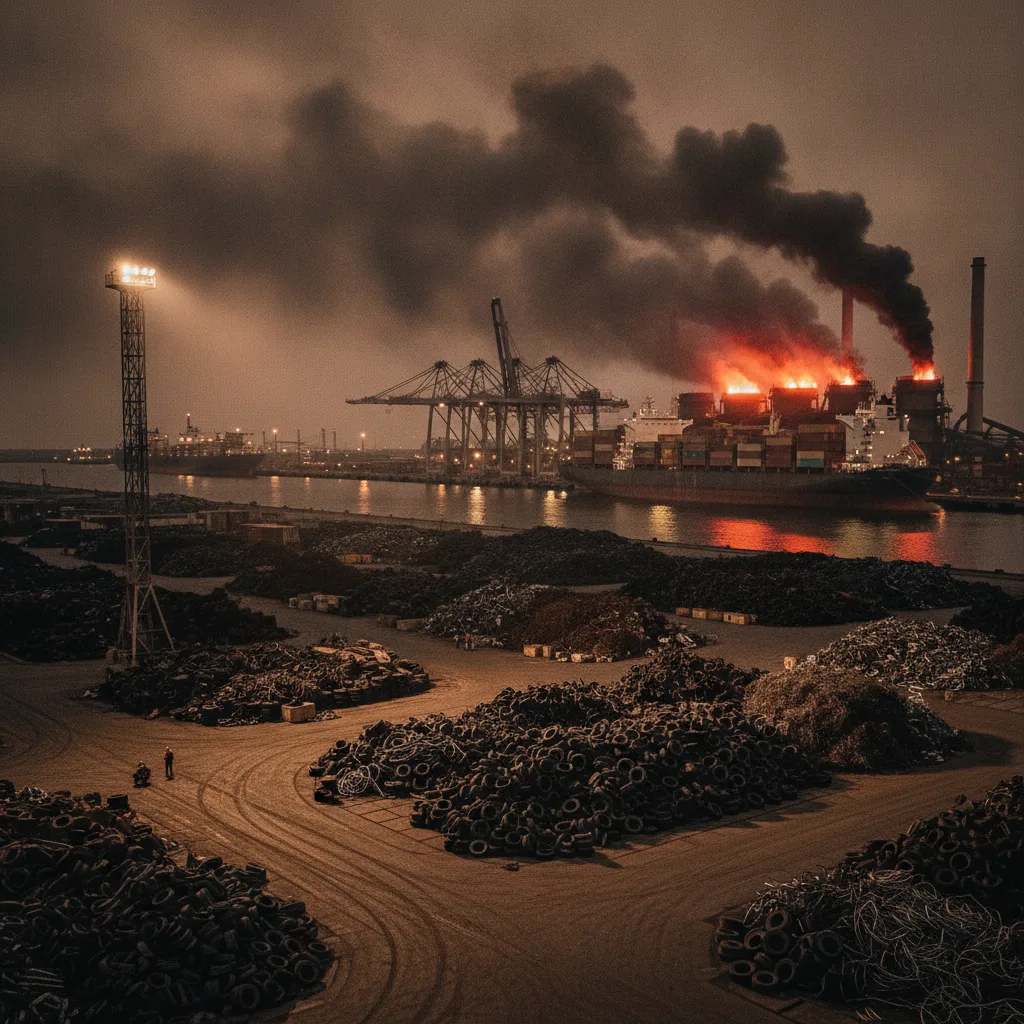
- ABC Coke, the US's largest foundry coke producer, has been operating on an expired air permit since at least 2023, prompting a court petition to force regulatory action.
- Buyers sourcing primary metals from non-compliant producers carry direct supply disruption risk: a facility shutdown forces spot-market scrambles at premium prices.
- GCC environmental enforcement frameworks are maturing rapidly — operators who treat compliance as optional today face the same permit-expiry exposure that is now litigated in Alabama courts.
- Secondary raw materials from certified, compliant recyclers provide a structural hedge: no permit liability, lower embodied carbon, and increasingly a contractual requirement from global off-takers.
A court petition filed in Jefferson County, Alabama in late 2026 put one of North America's most consequential industrial compliance failures on the public record: ABC Coke, the United States' largest producer of foundry coke, has been operating without a valid air permit — its 2023 renewal application left unresolved, the facility running regardless 1. The Southern Environmental Law Center filed on behalf of local residents to force regulators to act 1. For a Gulf industrial operator reading this from Riyadh, Dubai, or Jubail, the instinct may be to file this under "American regulatory dysfunction." That instinct is wrong.
What the ABC Coke case actually reveals about industrial compliance gaps
The mechanics of the Alabama situation are straightforward: a facility applies to renew its operating permit, the regulating authority fails to process the application within the statutory period, and the plant keeps running under what is often called "permit shield" continuity — a legal grey zone that differs by jurisdiction but generally allows operations to continue while renewal is pending 1. What makes the ABC Coke case notable is the scale. This is the nation's largest foundry coke producer, a critical upstream input for grey iron and ductile iron castings used across automotive, construction, and heavy machinery sectors 1.
The Hacker News discussion of the story captured the casual dismissal common in industrial circles — "go to the county courthouse, pay the $10, and renew it" 2. That framing misreads the situation entirely. Permit renewal at an industrial coke facility is not administrative housekeeping. It involves air quality modelling, fenceline emissions monitoring, community consultation, and sign-off from multiple agencies. When it stalls, it stalls for structural reasons — understaffed regulators, contested emissions data, or political pressure from operators who prefer ambiguity to scrutiny.
The legal petition asking a judge to compel agency action is the signal that ambiguity has run out 1. What follows is binary: the permit is renewed under conditions the operator may find commercially uncomfortable, or the facility faces shutdown risk. Either outcome has supply-chain consequences.
Why expired permits create downstream risk for metals buyers and manufacturers
A foundry coke facility that loses its operating authorisation does not wind down gradually. It stops. For manufacturers who have built production schedules around a single primary-coke supplier, that stoppage means emergency sourcing — spot markets, alternative grades, longer lead times, and price premiums that compress margins immediately.
This is the hidden liability embedded in procurement decisions that prioritise price and proximity over compliance status. A buyer who never asked whether their supplier's permits were current is not insulated from the consequences of the answer. They just discover the problem later, at a worse moment, with fewer options.
The risk compounds up the chain. An automotive casting supplier sourcing from an ABC Coke-dependent foundry is exposed to the same disruption. A steelmaker using pig iron from a non-compliant smelter faces the same logic. Compliance status is a credit risk embedded in every purchase order that references a primary-metal upstream.
The connection to the broader circular economy argument is direct: secondary raw materials — scrap metal, recycled aluminium, recovered copper — are produced by facilities that have typically invested more heavily in environmental compliance precisely because their business model depends on public and regulatory acceptance. A licensed scrap processor in a mature market operates under current approvals. Its product does not carry the permit-liability overhang that primary producers increasingly do.
How GCC regulators are moving in the same direction — faster than most operators expect
The Gulf regulatory environment is not Alabama in 2023. It is moving in a direction that Alabama's experience previews. Saudi Arabia's National Environment Strategy, the UAE's Federal Law No. 24 on Environmental Protection, and Qatar's expanding industrial licensing requirements are all tightening the conditions under which major emitters can operate. The enforcement gap between permit conditions and actual practice — which allowed ABC Coke to run years beyond its permit validity — is narrowing in the GCC as monitoring technology improves and as sustainability reporting obligations create documentary trails.
IFRS S1 and S2, which require GCC-listed companies to disclose material climate-related risks and dependencies, add another layer see our analysis of what this means operationally. A manufacturer that cannot demonstrate the compliance status of its primary-material suppliers will find that gap appearing in its own sustainability disclosure — and in the questions asked by its international customers and lenders.
The EU's Packaging and Packaging Waste Regulation (PPWR) sets minimum recycled-content thresholds that effectively make compliance verification of upstream suppliers a commercial requirement, not a preference see how PPWR affects Gulf traders. A Gulf exporter selling into European markets who cannot certify the provenance and compliance status of their input materials faces rejection at the port.
The Saudi local manufacturing push — which is generating significant new industrial capacity — is simultaneously generating more industrial waste and more demand for compliant secondary material inputs, as we examined in the context of Saudi Arabia's growing recycling gap. The compliance pressure and the circular-economy opportunity are the same force pointing in the same direction.
The supply-chain case for secondary raw materials over primary metals
The economics of this argument have shifted over the past three years. Secondary raw materials from compliant recyclers now carry a combination of advantages that primary metals increasingly cannot match:
1. No upstream permit liability. A licensed recycler's product is not contingent on a regulatory renewal process that could be litigated into a shutdown. The compliance risk sits with the recycler's own operations, which are visible and auditable. 2. Lower embodied carbon. Secondary aluminium requires roughly 95% less energy to produce than primary smelted aluminium — a differential that matters directly when customers and regulators price carbon. This is not a marketing claim; it flows from the thermodynamics of re-melting versus ore reduction. 3. Tariff resilience. As we covered in the context of US tariff impacts on GCC recycling trade, secondary material flows are less exposed to the primary-commodity tariff escalations that have disrupted metals markets since 2024. 4. Procurement requirement convergence. Global manufacturers — automotive OEMs, aerospace primes, consumer electronics brands — are converting voluntary recycled-content targets into supplier qualification requirements. Being a certified secondary-material supplier is increasingly a condition of being in the tender pool, not a differentiator within it. 5. GCC infrastructure demand alignment. The GCC's infrastructure investment wave creates direct demand for secondary construction materials — rebar from scrap, recycled aggregates, recovered copper for electrical systems. That demand is documented and growing, as we tracked in the GCC infrastructure and secondary materials opportunity piece.
Tarsyn Group's view: compliance pressure is a circular-economy tailwind, not a headache
The ABC Coke story is easy to read as a cautionary tale about regulatory dysfunction — a bureaucracy too slow to process a permit, a facility too large to shut down. That reading flatters nobody and changes nothing for a Gulf operator.
The more useful reading is structural: environmental enforcement gaps close. They close because litigation forces them shut, because monitoring technology makes evasion expensive, and because international trade partners require compliance evidence as a condition of market access. The question is not whether your upstream suppliers will face this pressure. The question is whether you have already diversified away from the exposure.
The circular economy is not primarily an environmental concept — it is an industrial risk-management framework. Facilities that run on secondary materials from compliant, auditable recyclers do not face the binary outcome of permit renewal or shutdown. They are insulated from the commodity-price volatility that hits primary-metal buyers when a major producer goes offline unexpectedly. And they are positioned to meet the procurement requirements of customers who are themselves under sustainability reporting pressure.
Tarsyn Group's position is that the transition to compliant secondary sourcing is not a cost to be managed but a margin to be captured — earlier movers establish supplier relationships, certifications, and logistics routes before they become congested and expensive. The ABC Coke situation is a preview of where this pressure lands eventually. The sensible response is not to wait for the Jefferson County moment in your own supply chain.
Operators who want to assess their exposure to upstream compliance risk — and map a practical path to secondary-material sourcing — should speak to Tarsyn Group's advisory team. The audit of your current supply chain is the logical first step, and the time to do it is before the petition is filed, not after.