When Green Claims Meet Bulldozers: Big Tech's ESG Problem
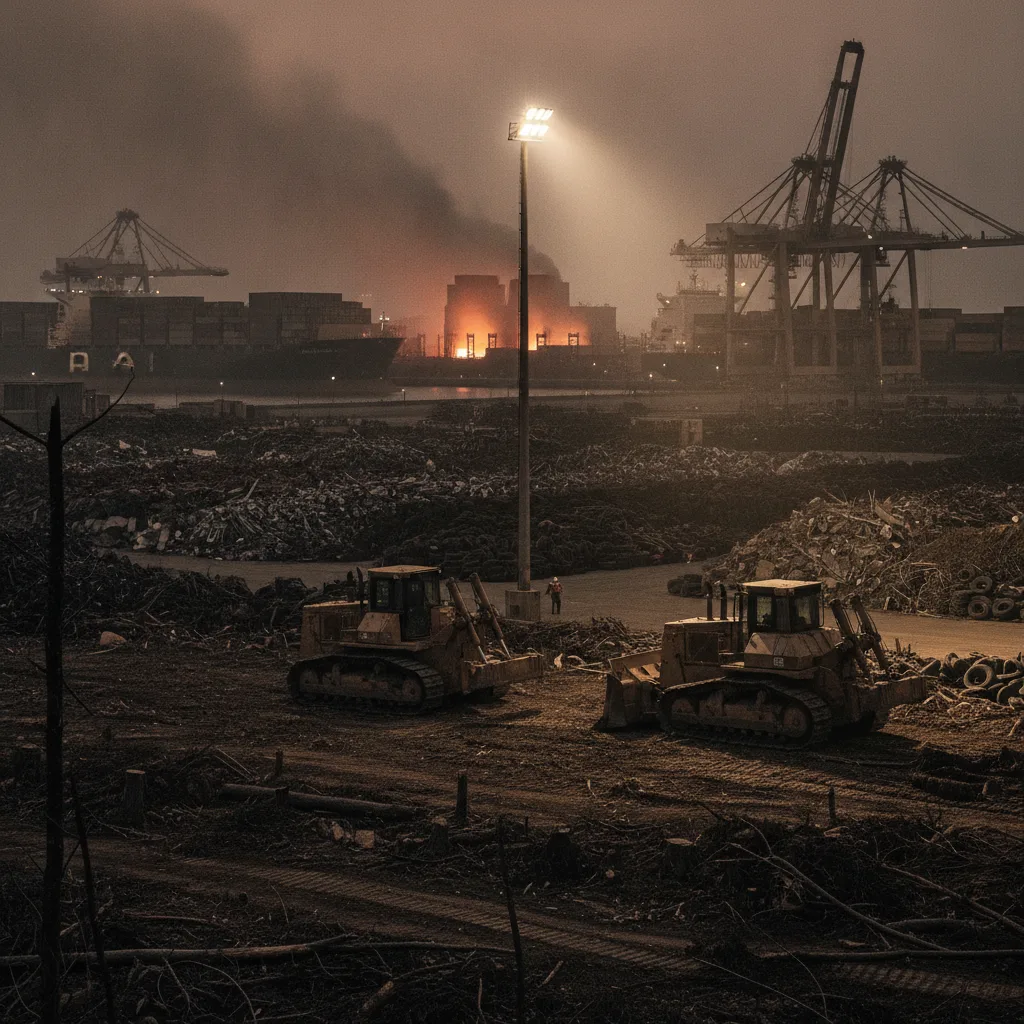
- Google's Finnish subsidiary was ordered to halt work at two data center sites in Muhos and Kajaani after clearing 330 hectares of forest without completing mandatory environmental impact assessments.
- Finland's Licensing and Supervision Agency (LVV) imposed the halt across a €13bn expansion project — proof that EIA is now a hard construction gate, not a post-approval formality.
- GCC industrial operators face equivalent exposure: regional permitting frameworks are tightening in parallel with IFRS S1/S2 reporting mandates and EU supply-chain due-diligence rules.
- Embedding environmental-impact assessment into capital-project planning from feasibility stage reduces cost and delay compared with retroactive compliance — the core operational lesson from the Finland case.
In late September 2026, satellite images of a Finnish forest told a story that no corporate sustainability report had prepared anyone for: 330 hectares of trees — 815 acres — felled and stripped, access roads carved through the terrain, drainage systems rerouted. The company responsible was not a rogue logging operation. It was Google. 1
The incident cuts to the centre of the ESG manufacturing debate with unusual clarity. A company that publishes some of the most detailed sustainability disclosures in the technology sector had deployed capital — €13 billion across multiple sites in northern Finland — without completing the environmental impact assessments that Finnish law requires before ground is broken. 4 The Finnish Licensing and Supervision Agency (LVV) ordered Google's project subsidiary, Tuike Finland Oy, to halt all preparatory work at the Muhos and Kajaani sites by 23 October at the latest. 3 The order stands until the EIAs are finished.
This is not, fundamentally, a story about one company's failure. It is a live demonstration of what happens when ESG governance operates at the corporate-communications layer but not at the capital-deployment layer — and that gap is as relevant to a Gulf manufacturer planning a new facility as it is to a Silicon Valley hyperscaler.
---
What Happened in Finland — and Why It Isn't Just a Google Story
The activities Tuike Finland Oy carried out before the halt are worth listing precisely, because they map directly onto what early-stage industrial site preparation looks like anywhere: clearing trees, removing topsoil, building access roads and storage facilities, digging excavations, altering drainage ditches and culverts. 3 These are not fringe activities — they are the first physical steps of almost every large industrial build.
Tommi Muilu, who leads the LVV's environmental department, stated that "the measures in question will change the environment and cause impacts, the identification and assessment of which are among the key objectives of the EIA procedure." 3 The point is precise: the EIA exists specifically to evaluate these early interventions, not to rubber-stamp them afterward.
Google's public response acknowledged falling "short of our own high standards." 2 But observers noted immediately that this framing mischaracterises what occurred: the company had not failed to meet a voluntary internal benchmark. It had breached a statutory obligation. The distinction matters enormously for governance. Internal standards can be adjusted; national law cannot.
---
Environmental Impact Assessment Is Becoming a Hard Gate, Not a Formality
For decades in many jurisdictions, EIA was treated as a procedural box to check — something the legal team managed in parallel with engineering, often on a timeline that assumed approval. That era is closing.
The LVV's stop-work order on a €13 billion project demonstrates that regulators now treat pre-EIA site activity as a substantive violation, not an administrative oversight. 4 The halt will likely generate litigation, administrative court delays measured in months or years, and reputational exposure that no subsequent assessment can fully erase. The cost of non-compliance — in delay alone — almost certainly exceeds what a well-resourced EIA process at feasibility stage would have cost.
This trajectory is not limited to northern Europe. The EU's Corporate Sustainability Due Diligence Directive and the IFRS S1/S2 sustainability reporting standards (now being adopted across GCC capital markets) both require companies to demonstrate that environmental governance is embedded in operational decision-making — not just disclosed in annual reports. For a deeper look at what IFRS S1 and S2 demand from Gulf operators specifically, see IFRS S1 & S2: What GCC Industrials Must Do Now.
---
How GCC Industrial Operators Are Exposed to the Same Risk
Gulf manufacturers expanding capacity — whether in petrochemicals, metals processing, logistics infrastructure, or data hosting — face a structurally identical risk to the one Google encountered in Finland. The mechanics differ by jurisdiction; the failure mode is the same.
Three specific exposure points deserve attention:
1. Permit sequencing. Projects that begin site preparation before environmental permits are finalised — even where local custom has tolerated this — face increasing enforcement as Gulf regulators modernise frameworks. The cost of a stop-work order on a heavy-industrial site is measured in millions per idle week. For context on what permit failures look like in the GCC metals sector, see What Happens When Industrial Permits Expire — and Who Pays.
2. Supply-chain due diligence. European buyers and financiers now require upstream suppliers — including Gulf manufacturers — to evidence environmental governance across their operations. A facility that cannot produce EIA documentation for its expansion will face procurement de-listing, not just regulatory sanction.
3. Disclosure standards. IFRS S2 requires climate-related risk disclosure. A stop-work order triggered by environmental non-compliance is a material operational risk event that must be disclosed. Companies that have not wired EIA into project governance will find themselves disclosing incidents rather than managing them.
The parallel to data-center energy governance is also direct. As AI infrastructure demand drives capital into new industrial builds across the Gulf, the same pressure that pushed Google into premature site clearance — speed to capacity — will test Gulf operators' project governance. See What California's AI Data-Centre Laws Mean for Gulf Industry for the regulatory direction of travel.
---
The Circular-Economy Case for Proactive Environmental Governance
There is a harder commercial argument for front-loading environmental assessment that goes beyond compliance avoidance.
Industrial operators committed to circular-economy principles — recovering materials, minimising waste streams, reducing extraction — already understand that environmental outcomes are upstream of operational decisions, not downstream of them. The same logic applies to land use and ecosystem impact. A facility sited and designed with full EIA data available makes better decisions about drainage, topsoil management, green-space integration, and long-term remediation liability. These are not soft benefits; they translate into lower operating costs and lower exit-liability on asset sales.
Gulf manufacturers investing in secondary materials and resource recovery — the operational territory Tarsyn Group works in daily — are particularly exposed to this dynamic. The credibility of a circular-economy value proposition collapses if the facility producing it carries unresolved environmental violations. The reputational arithmetic is straightforward: one stop-work order anywhere in the supply chain can void the ESG premium a product commands in European markets.
For operators looking at how Saudi Arabia's industrial expansion is creating both opportunity and recycling obligations, Saudi Local Manufacturing Is Growing — So Is Its Recycling Problem lays out the structural picture.
---
Tarsyn's View: Build the Assessment In, Not On
The lesson from Finland is not that industrial growth should slow down. Google's €13 billion investment in Finnish data-center capacity represents exactly the kind of large-scale infrastructure commitment that drives employment, technology transfer, and regional economic development. The problem was not the ambition; it was the sequencing.
Environmental impact assessment is not a brake on capital deployment — it is a navigation instrument. Run it early, and it tells you where to build, how to build, and what mitigation to price into the project. Run it late — or skip it — and it becomes a stop-work order, a legal process, and a public-relations event that costs more than the assessment ever would have.
For GCC industrial operators, the practical implication is concrete: any capital project above a material threshold should have an environmental-governance lead embedded in the project team from feasibility, not added at execution. That lead needs authority — actual authority, not advisory status — to pause procurement if permit sequencing is out of order.
This is the governance structure that ESG manufacturing actually requires. Not a sustainability report. Not a carbon-offset purchase. A named person, in the room, with the project plan, before the first machine moves.
If your organisation is planning industrial expansion and needs to stress-test its environmental governance against current regulatory expectations, talk to Tarsyn Group. We work from the operational floor — permits, tonnage, compliance timelines — not from a presentation deck.
For a related view on how AI's resource demands are creating circular-economy opportunity (and governance risk) for Gulf operators, see AI's Resource Hunger Is a Circular Economy Wake-Up Call.
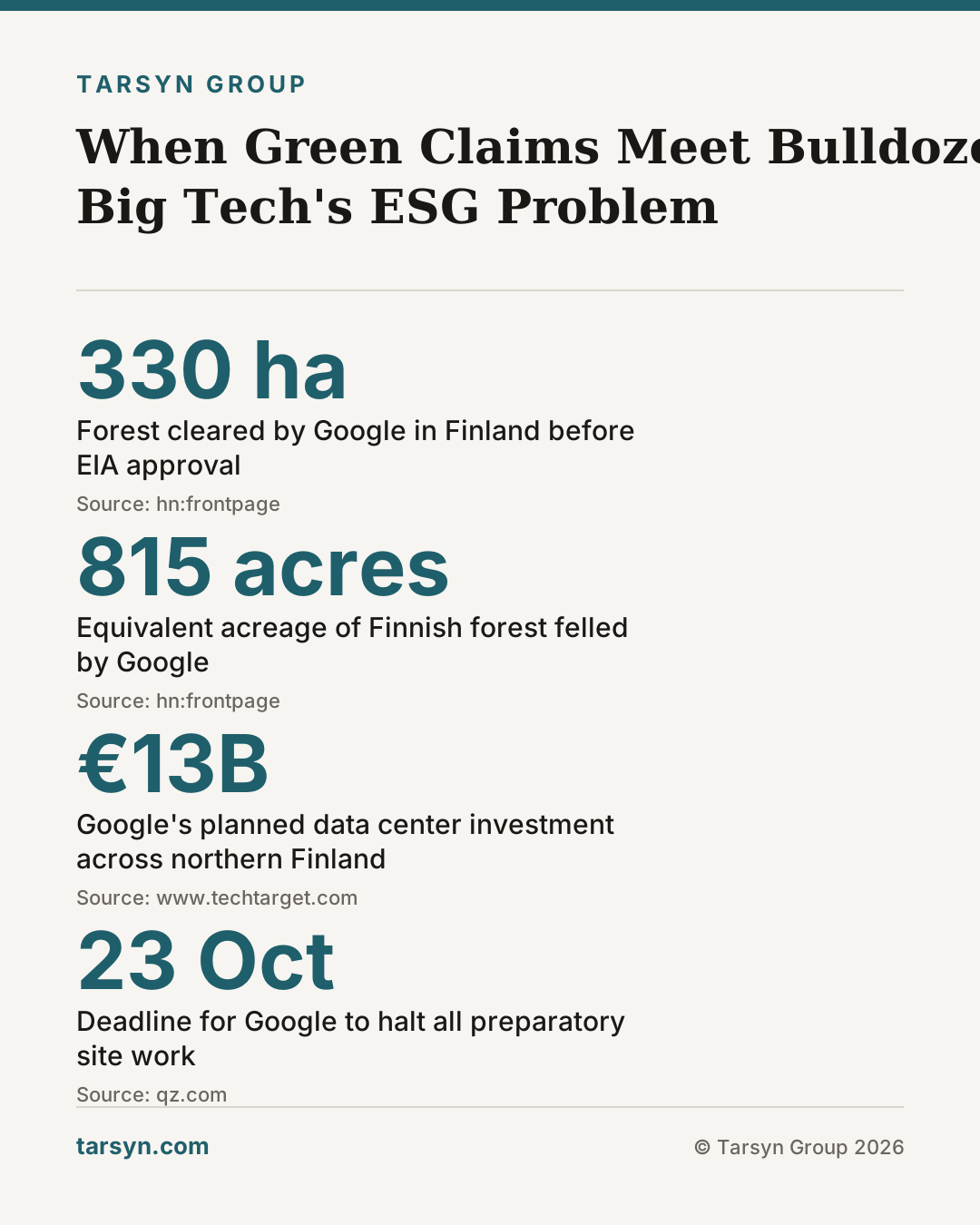
!When Green Claims Meet Bulldozers: Big Tech's ESG Problem — the numbers at a glance
- Google is illegaly cutting forest to build data centers — hn:frontpage
- Google is illegaly cutting forest to build data centers (discussion) — Hacker News
- Finland orders Google to halt data center work over forest clearing — qz.com
- Finland tells Google to halt site work on €13B data center expansion | TechTarget — www.techtarget.com