California's AI Data Laws: A Gulf Compliance Preview
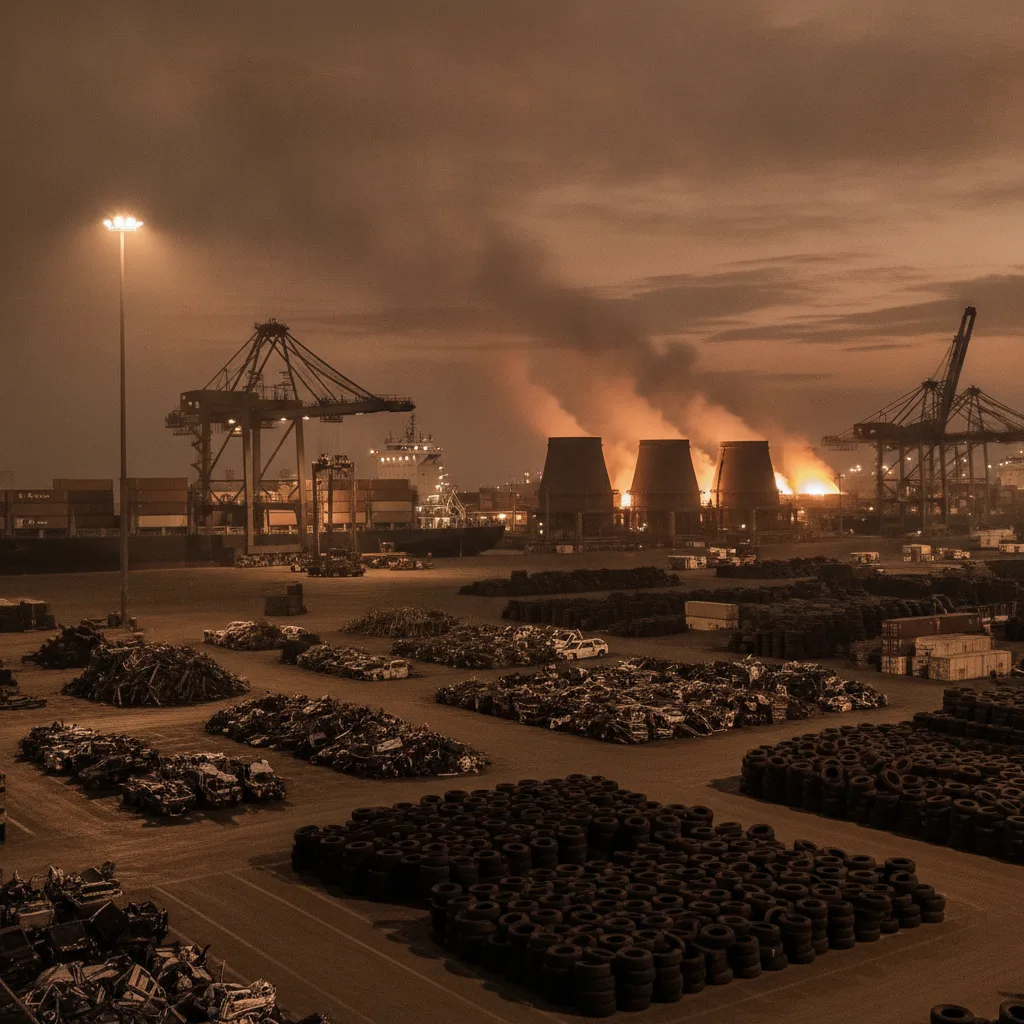
- California Governor Newsom signed seven binding data centre laws in September 2026, requiring operators to cover grid upgrade costs and disclose water demand — moving resource accountability from voluntary pledge to legal obligation.
- GCC industrial operators face an analogous shift: Saudi Vision 2030 environmental benchmarks are tightening from aspirational targets into enforceable procurement and licensing conditions.
- Circular-economy readiness — closed-loop water use, waste-heat recovery, recycled-content procurement — is transitioning from a competitive differentiator into a compliance baseline for heavy industry.
- Five operational shifts (resource audits, water-efficiency retrofits, recycled-input sourcing, grid-cost modelling, and sustainability reporting) can position Gulf manufacturers ahead of the regulatory curve now.
California's latest move against AI infrastructure excess landed not as a policy discussion paper but as seven signed laws — binding, cost-allocating, and effective. Governor Newsom's September 2026 package places data centre operators on the financial hook for grid upgrades, water demand disclosures, and environmental land-use review.4 For a Gulf manufacturer watching Saudi Vision 2030 environmental benchmarks tighten from aspirational to enforceable, the signal is direct: resource accountability is leaving the realm of voluntary commitment.
What California's seven data centre laws actually require
The legislation — AB 1577, AB 2383, AB 2469, AB 2619, SB 886, SB 887, and SB 1168 — is the most comprehensive data centre regulatory package enacted by any US state.2 Its core mechanics:
1. Grid cost allocation. Data centre developers must bear the costs of grid upgrades their facilities require, rather than spreading those costs across existing electricity customers.2 2. Energy procurement compliance. Affected facilities must comply with California's energy procurement rules and support additional electricity supply needed to meet their demand.2 3. Water disclosure. Proposed facilities face mandatory disclosure of expected water demand, available supply, efficiency measures, and drought contingency planning.2 4. Developer-funded water infrastructure. Developers are responsible for any water supply upgrades their projects require.2 5. Land-use and environmental review. Local governments gain more information on energy, water, workforce, and land use when evaluating proposed facilities.4 6. Reporting requirements. Operators must report on water and electricity use on an ongoing basis.4 7. Community cost protection. The package explicitly prevents working families from shouldering utility cost increases driven by data centre demand.4
The underlying logic is structural: whoever profits from a resource-intensive facility pays for the infrastructure it requires. That is not a California idiosyncrasy — it is where industrial regulation broadly is heading.
Why resource regulation is moving faster than operators expect
Voluntary sustainability pledges held regulatory pressure at bay for roughly a decade. That window is closing. California's package follows the EU's energy efficiency and water scarcity frameworks, IFRS S1 and S2 mandatory sustainability disclosures arriving in GCC capital markets, and tightening procurement conditions tied to green industrial policy. As we noted in IFRS S1 & S2: What GCC Industrials Must Do Now, the disclosure requirements alone are reshaping how capital allocators evaluate Gulf industrial assets.
The acceleration has a structural cause: AI infrastructure is driving electricity and water demand at a scale that grid operators and municipal water suppliers cannot quietly absorb. California's data centres consume substantial electrical capacity — particularly facilities dense with AI accelerators — and cooling systems at that scale require significant water volumes.2 When the public cost becomes visible, legislation follows. Industrial operators in any energy- or water-intensive sector should read that sequence carefully.
The GCC parallel: Vision 2030 targets and green industrial policy
Saudi Arabia's Vision 2030 framework has long carried environmental performance targets. What has changed is the mechanism of enforcement. Green industrial zones, localisation requirements, and export-linked sustainability benchmarks are shifting those targets from ministerial aspiration to commercial gate. A manufacturer seeking to supply a NEOM-linked project or qualify for SAUDI MADE status faces environmental performance criteria that were absent three years ago.
The circular economy — defined operationally as closed-loop resource use, recycled-content procurement, waste elimination, and water reuse — sits at the centre of this shift. Saudi Arabia's emerging industrial policy increasingly favours facilities that demonstrate resource efficiency, not just volume output. This trajectory is explored in detail in رؤية 2030 والاقتصاد الدائري: ما يعنيه ذلك للصناعة الخليجية.
The PPWR packaging regulation tightening in Europe adds another dimension: Gulf exporters to EU markets face recycled-content thresholds that feed directly back into sourcing decisions for Saudi and UAE manufacturers. Regulation in one major market shapes supply chains in others.
Five operational shifts Gulf manufacturers should make now
Waiting for a Gulf equivalent of California's seven bills before acting is a losing strategy. Compliance infrastructure takes time to build. The operators who fare best under new regulation are those who have already operationalised the requirements.
1. Conduct a full resource baseline audit. Establish exact figures for electricity consumption (kWh/tonne of output), water withdrawal (m³/tonne), and waste generation by stream. Regulators and investors increasingly demand this data; operators who cannot produce it quickly are disadvantaged in both licensing and capital markets.
2. Retrofit for water efficiency. Cooling systems, process water loops, and dust suppression are common sources of industrial water waste in GCC facilities. Closed-loop retrofits reduce both water cost and the volume subject to future discharge regulation. The record ocean temperatures documented in the Gulf are already affecting desalination economics — water is not a free input.
3. Shift procurement toward recycled-content inputs. As Saudi local manufacturing growth outpaces its recycling infrastructure, operators who source recycled materials position themselves for both cost stability and regulatory compliance. Recycled-content mandates are a near-certain feature of coming green industrial policy frameworks.
4. Model grid-connection and energy costs under tightening rules. California's model — charging infrastructure costs to the consuming operator — is not unique. Gulf utilities under fiscal pressure have commercial incentives to adopt similar cost-allocation approaches. Operators building new capacity should stress-test project economics against that scenario now.
5. Build sustainability reporting infrastructure before it is mandatory. IFRS S2 climate-related disclosure, Vision 2030 reporting requirements, and customer-led supplier sustainability questionnaires are converging. The data collection, verification, and reporting systems needed to satisfy all three overlap significantly. Building them under deadline pressure is expensive; building them proactively is an operational investment that also serves the compliance function.
Tarsyn Group's view: compliance pressure is the circular economy's best accelerant
The circular economy has been debated in Gulf industry circles for years as a strategic aspiration. California's legislation illustrates why it is about to become something more immediate: the legal and commercial baseline against which industrial operations are measured.
This is not pessimism. For operators who move first, compliance readiness is a sourcing advantage, a licensing advantage, and increasingly a financing advantage. Lenders and equity investors applying IFRS S1/S2 frameworks will price risk differently across facilities that can and cannot demonstrate resource efficiency. The circular economy's value proposition has always been sound; what it previously lacked was enforcement. Enforcement is arriving.
The five operational shifts above are not aspirational. Each one reduces costs, reduces risk, and builds the data infrastructure that regulators and capital markets are about to require. Operators who treat circular-economy readiness as a compliance preparation rather than a marketing exercise are the ones who will find the coming regulatory environment navigable rather than punitive.
Tarsyn Group works with Gulf industrial operators across recyclables trade, resource efficiency advisory, and sustainability operations. If you are mapping your exposure to tightening resource regulation, speak with the Tarsyn Group advisory team. For the energy dimension of AI infrastructure's industrial impact, see AI's Dirty Power Bill: What Industrial Operators Must Know.