Record Ocean Heat: What It Means for Gulf Industry

- Global ocean surface temperature hit a record 21.1°C, driven by both El Niño and decades of human-caused warming — a signal regulators are watching in real time.
- EU CBAM charges on carbon-intensive goods came into effect on 1 January 2026, directly raising export costs for Gulf aluminium, steel, and chemicals producers.
- GCC countries with 84% urban populations generate industrial and consumer waste streams large enough to support commercially viable secondary-materials operations at scale.
- Secondary raw materials now function as a cost hedge against climate-linked supply disruptions and tightening carbon border charges — not as an ESG branding exercise.
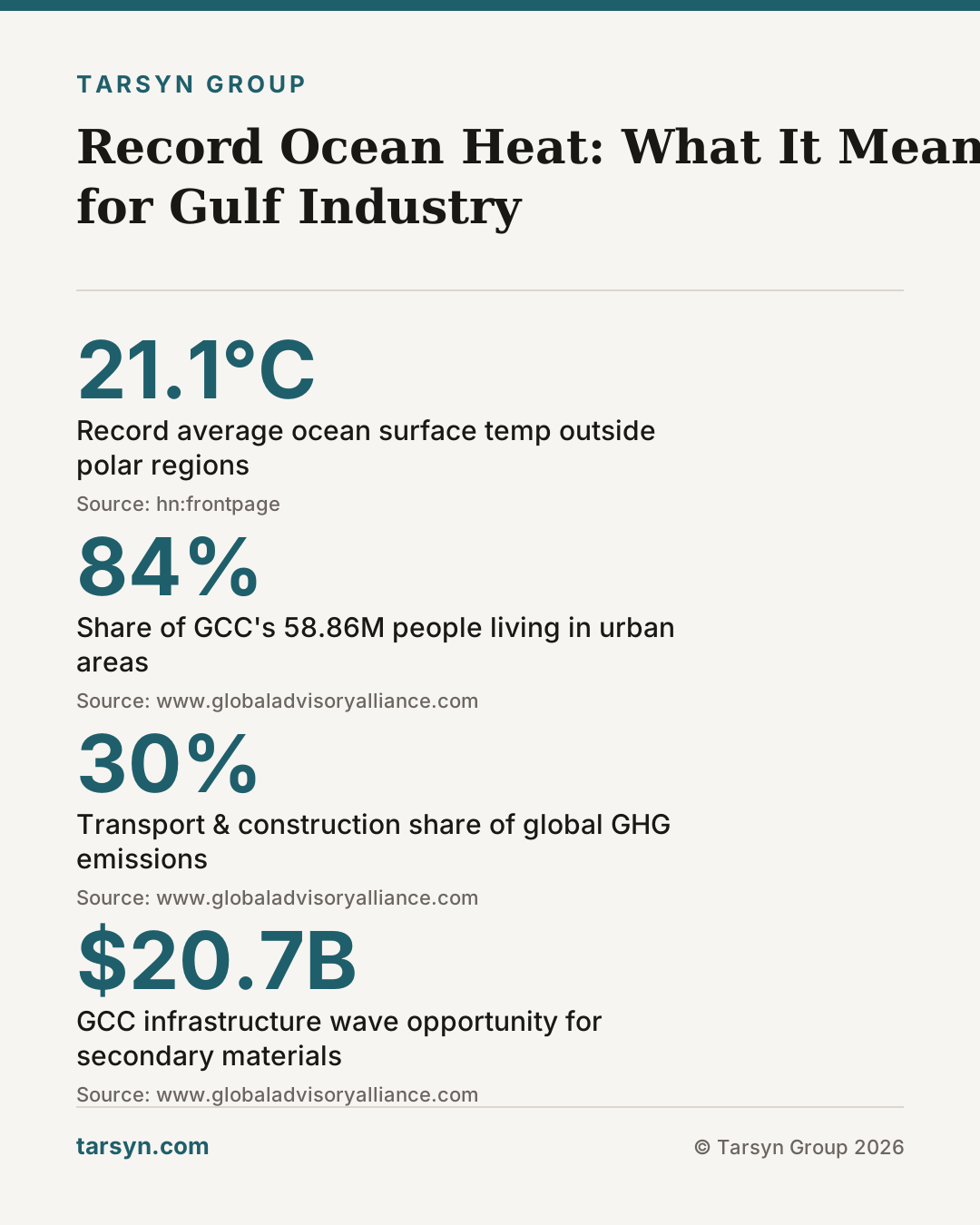
On Saturday, the planet's oceans crossed a threshold scientists had hoped to avoid for longer: an average surface temperature of 21.1°C outside the polar regions, beating the previous record of 21.09°C set in March 2024. 1 The European Copernicus climate service confirmed the figure. Dr Samantha Burgess, Copernicus deputy director, was direct: "El Niño is adding heat to the system, but it is doing so on top of decades of human-driven warming." 1 For Gulf manufacturers and commodity traders, the instinct is to file this under science news and move on. That instinct is now expensive.
What the ocean temperature record actually signals for industrial supply chains
Ocean heat is a physical forcing mechanism, not a metaphor. Warmer seas supercharge extreme weather, raise sea levels, and disrupt the atmospheric and current patterns that underpin global shipping and logistics. 1 For an operator moving materials through the Red Sea corridor or the Strait of Hormuz, that means compounding disruption risk on top of the geopolitical volatility already priced into freight rates.
There is a less obvious but equally consequential effect: every record like this one gives climate regulators a concrete data point. When Copernicus confirms a new all-time high, the political friction around carbon pricing falls. Policymakers in Brussels, Riyadh, and Abu Dhabi can point to the instrument panel rather than argue from models. The policy timeline for industrial operators compresses.
How climate milestones accelerate CBAM and GCC green regulation
The EU's Carbon Border Adjustment Mechanism is no longer a proposal or a transition instrument. On 1 January 2026, imports of carbon-intensive goods into the European Union became subject to full CBAM charges. 3 That covers the categories Gulf exporters depend on: steel, aluminium, chemicals, and related inputs. A Gulf producer without credible low-carbon process data now faces a measurable price penalty at the EU border — not a hypothetical future cost.
The timeline matters because climate records accelerate political will. Each new ocean temperature high, each extreme weather event tied to sea-surface anomalies, increases the probability that CBAM scope widens, that phase-in periods shorten, and that GCC governments front-run EU pressure with domestic carbon regulations of their own. Saudi Vision 2030, the UAE Net Zero 2050 commitment, and Qatar's National Environment and Climate Change Strategy are all live frameworks — not aspirational documents. The regulatory environment for Gulf industrial operators is tightening on two axes simultaneously: export markets and domestic mandates.
For a trader or manufacturer still optimising against 2023 assumptions, the cost of that miscalibration compounds quarterly.
The commodity trader's exposure: why secondary raw materials pricing is shifting
Secondary raw materials — recycled aluminium, reclaimed steel, post-industrial polymers — carry a structural advantage in a CBAM world: lower embedded carbon intensity compared to their primary equivalents. That differential is now being priced into procurement decisions by European buyers who must account for CBAM charges on their inputs.
The GCC is well-positioned to supply this demand domestically and across the region, but the infrastructure build-out is still catching up to the opportunity. The region's 58.86 million people — 84% of whom live in urban areas — generate substantial industrial and post-consumer waste volumes. 4 GCC governments are actively developing waste-management and advanced recycling capacity to capture that feedstock. 4 The commercial logic is straightforward: secondary materials sourced and processed regionally avoid both the primary extraction cost and the carbon-intensity premium that CBAM is beginning to monetise.
For traders specifically, the risk sits in two places. First, primary-material positions become harder to move into EU markets as CBAM charges raise the total landed cost. Second, secondary-materials supply in the region is still fragmented, meaning buyers who act now to secure reliable sources lock in a margin advantage over those who wait for the market to mature. The US-Canada tariff disruptions are already reshaping global scrap metal flows — as explored in our analysis of what the US-Canada tariff war means for scrap metal traders — and those dislocations create windows that prepared traders can exploit.
Circular economy as a practical risk buffer, not a branding exercise
The circular economy argument for Gulf operators is fundamentally a risk-management argument, not a sustainability communications exercise. Three specific exposures are reduced by integrating secondary materials into procurement and production:
1. Carbon border cost exposure. Secondary materials carry lower embedded carbon. In a CBAM-priced world, that differential translates directly to export margins. 2. Primary commodity volatility. Ocean heat events correlate with supply disruptions in mining, smelting, and primary processing — sectors that are energy-intensive and geographically concentrated. Secondary materials draw from a more distributed, urban-industrial feedstock that is less sensitive to those shocks. 3. Regulatory compliance cost. CBAM requires documented emission data, not declarations. 3 Operators already running circular procurement have the data infrastructure in place. Those who start from zero face both transition costs and documentation gaps that can delay or complicate export transactions.
The transportation and construction sectors — two of the GCC's largest industrial categories — account for 30% of global greenhouse gas emissions, making decarbonisation pressure in those sectors particularly acute. 4 Circular practices in materials sourcing reduce that exposure upstream, before it reaches the regulatory checkpoint.
This is also the commercial logic behind the GCC's $20.7 billion infrastructure wave — an opportunity for secondary materials operators that is only growing as build-out timelines accelerate. Regional developments like Blue Planet's expansion into Dubai signal that institutional capital is already moving toward circular economy infrastructure in the Gulf. The question is whether industrial operators are building procurement relationships ahead of that capacity, or scrambling to catch up after it matures. Separately, waste-gas monetisation — detailed in our piece on turning waste gases into chemicals — illustrates how the same circular logic applies across the industrial stack, not just to solid materials.
Tarsyn Group's view: the cost of waiting just got higher
Every new climate record is also a regulatory accelerant. The 21.1°C ocean reading published this week is not a future warning — it is current evidence that the physical and policy systems are moving faster than most industrial operators' planning cycles. 1
Recycling and secondary materials have been discussed in the GCC as an ESG commitment or a government-led initiative. That framing is now commercially inaccurate. Secondary materials are a hedge — against CBAM charges on primary inputs, against climate-linked supply disruption, and against the cost of building emission-data infrastructure under pressure rather than ahead of it.
The operators who are moving fastest are those who have mapped their primary material inputs against CBAM carbon-intensity categories, identified regional secondary-material suppliers capable of meeting volume and quality specifications, and begun generating the process-emission documentation that compliance requires. The operators who are moving slowest are accumulating a cost disadvantage that compounds with each regulatory tightening cycle.
Tarsyn Group works directly with Gulf industrial operators and traders on exactly this transition — from primary-dependent procurement toward verified secondary-material supply chains that reduce CBAM exposure and build regulatory resilience. If your operation is still assessing exposure rather than acting on it, the time and cost of that assessment are rising. Talk to Tarsyn Group about your sustainability operations.
For Saudi industrial operators looking at this through a cost-reduction lens, the practical steps are detailed in our analysis of sustainable cost reduction for Saudi industrial operators. For those tracking how US tariff policy is reshaping recycling trade flows into and out of the region, see what US double-digit tariffs mean for GCC recycling trade.
The ocean temperature record will be broken again. Each time it is, the cost of inaction for Gulf industrial operators rises with it.
!Record Ocean Heat: What It Means for Gulf Industry — the numbers at a glance
- Oceans hit highest temperature on record — hn:frontpage
- The EU’s CBAM and Gulf Countries: An Analysis of Early Evidence — www.orfonline.org
- Circular Economy in the GCC: Status and Opportunities — www.globaladvisoryalliance.com