US–Canada Tariff War: What It Means for Scrap Metal Traders
- Canada matched US tariffs dollar-for-dollar after trade talks collapsed on 19 August, covering nearly $20bn of Canadian imports subject to a threatened 50% US levy.
- Trade wars force multinational buyers to relocate sourcing and reroute supply chains, lifting spot availability in secondary markets outside North America.
- Diverted Canadian scrap volumes will reprice Atlantic and Asian feedstock corridors — GCC buyers who reposition sourcing now face less margin compression than those who wait.
- US steel and aluminum tariffs have a documented history of inflating downstream costs across construction, automotive, and industrial sectors — a pattern now repeating.
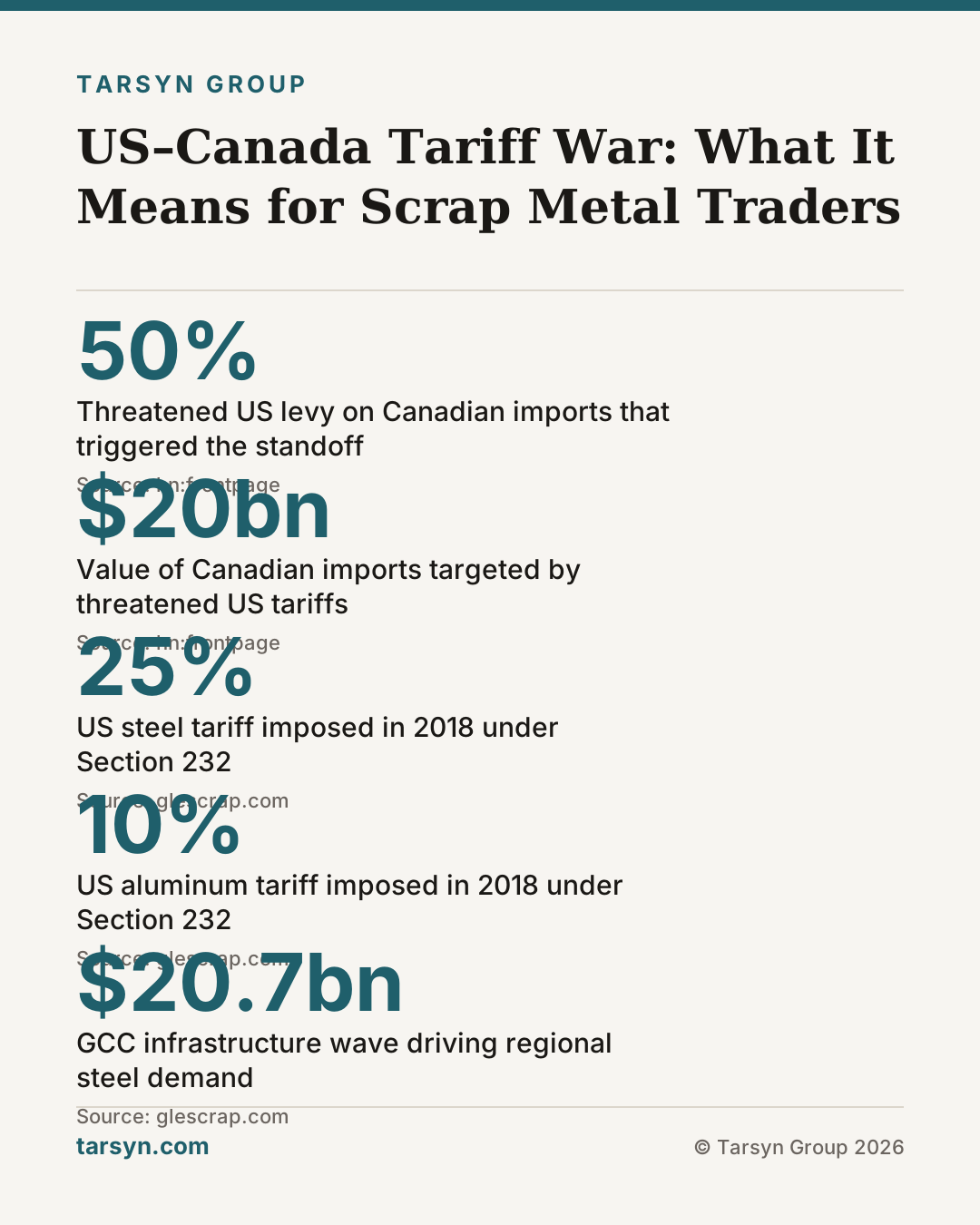
On the evening of 19 August, Canadian Prime Minister Mark Carney walked to a podium and ended weeks of trade negotiations in a single sentence. Canada would match US tariffs "dollar for dollar." The trigger: a threatened 50% US levy on nearly $20bn of Canadian imports, briefly paused for talks that collapsed at the last minute over terms Carney called "unfair, uneconomic" and a sign that no deal with Washington could be trusted 1. For scrap metal traders watching from Dubai, Riyadh, or Abu Dhabi, this was not a distant political headline. It was a feedstock pricing event.
What the US–Canada standoff actually covers — and why metals are caught in it
The US–Canada dispute is not a surgical strike on one commodity. It covers a wide array of Canadian goods 1, and metals are structurally embedded in that list. The US has a documented history of using metal tariffs as a primary trade lever: 25% steel and 10% aluminum tariffs were imposed in 2018 under Section 232 of the Trade Expansion Act, and a 30% steel tariff was applied as far back as 2002 3. Each round of tariffs has inflated costs across construction, automotive manufacturing, appliances, and packaging — industries that depend on both primary and secondary metal inputs 3.
Scrap metal sits at the intersection of every one of these supply chains. It is the feedstock for electric arc furnace (EAF) steelmaking, which dominates North American and increasingly Gulf steel production. When tariff barriers go up between the US and its largest trading partner, the secondary raw materials that move freely across that border — ferrous scrap, aluminum scrap, copper-bearing material — suddenly face cost friction or outright rerouting pressure. The commercial logic is straightforward: Canadian sellers look for non-US buyers; US mills look for non-Canadian sources. Both searches land in the same global spot market that Gulf traders also buy from.
How scrap and secondary raw material flows get rerouted when North America locks up
Trade wars do not destroy supply — they redirect it. Research on global trade conflict finds that when tariffs rise, multinational companies tend to relocate production units or search for new markets, increasing uncertainty and production costs across the chain 4. For physical commodity traders, that uncertainty is a signal, not a wall.
When the US–Canada corridor tightens, Canadian scrap exporters accelerate existing diversification efforts. Discussions in trade and policy circles indicate that Canada is already pursuing stronger ties with European and Asian partners as a deliberate response to US trade pressure 2. In practical terms, more Canadian ferrous and non-ferrous scrap flows toward Atlantic ports — Rotterdam, Antwerp, and feeder markets across North Africa and the Eastern Mediterranean. Asian buyers, particularly in South and Southeast Asia, also become more active Canadian counterparties.
This volume shift does two things simultaneously. It softens Atlantic spot prices for scrap grades that were previously absorbed by US mills. And it tightens the alternative sourcing options that North American buyers scramble to replace, pushing up prices in those sub-markets. The net effect is a repricing event — not a shortage — that moves faster than most procurement cycles.
Three price and supply effects GCC metal traders should model right now
The Gulf is not a passive observer in this dynamic. GCC countries are active importers of ferrous scrap, aluminum scrap, and finished steel products. Here are three specific effects worth stress-testing in any trading position:
1. Atlantic scrap spot softening. As Canadian exporters seek non-US buyers, Atlantic market availability rises. Traders with European or North African supplier relationships can source additional volume at potentially compressed prices — temporarily. This window closes as other buyers recognise the same opportunity.
2. Asian benchmark divergence. If North American demand for Asian scrap grades falls (because US mills are protecting domestic sourcing and retaliating against Canadian imports), Asian origin prices may soften relative to historical spreads. Gulf traders who source from South Asia — a major scrap and billet origin for the region — should watch those differentials weekly, not quarterly.
3. Downstream cost inflation in finished steel. Tariffs on steel and aluminum have a consistent track record of raising costs for manufacturers who use those metals 3. If North American finished steel becomes more expensive domestically, re-export and diversion of semi-finished products (billets, hot-rolled coil) can increase. GCC buyers who import finished products may see availability improve in some grades while prices remain sticky — a classic tariff distortion that rewards patient, well-networked buyers.
Which trade corridors become more attractive as North American volumes shift
When a major bilateral corridor disrupts, traders who have already built relationships in secondary corridors capture the margin others lose to reactive spot buying. Based on the current flow dynamics, three corridors deserve immediate attention from Gulf-based operators:
- EU → GCC: European scrap processors and traders benefit from increased Canadian inflow. They can offer surplus volume to Gulf buyers at competitive rates. Relationships with processors in Germany, the Netherlands, and the UK are worth activating now, not when spot prices have already reflected the news.
- South Asia → GCC: India and Pakistan are significant sources of processed scrap and re-rollable material. The India-US trade relationship also faces its own friction 4, making Indian sellers motivated to grow Gulf business. Bilateral deals structured now lock in volume before the market reprices.
- East Africa and Turkey: Turkey is one of the world's largest scrap importers and its pricing serves as a global benchmark. Monitoring Turkish import data gives GCC traders a real-time read on where Atlantic scrap pricing is heading — and Turkish re-export of semi-finished steel into the Gulf is a lever worth understanding.
The GCC's $20.7bn infrastructure wave reinforces why these corridors matter structurally. Domestic demand for steel and secondary materials is growing from construction and industrial expansion — and that demand will be satisfied from wherever supply is cheapest and most reliable, not from wherever it has historically come.
Tarsyn Group's view: treat disruption as a sourcing window, not a headline
The US–Canada tariff standoff will generate weeks of commentary. Most of it will focus on political dynamics — whether Carney and Trump return to the table, whether Canada's retaliatory measures hold 1. That commentary is useful context, but it is not a trading strategy.
The commercial reality is this: when two of the world's largest trading economies impose matching tariffs on each other's goods, the volumes that previously moved between them do not disappear. They reprice and reroute. For GCC traders, the question is not whether this repricing creates an opportunity — it does. The question is whether your sourcing relationships and procurement intelligence are positioned to capture it before spot prices reflect the new equilibrium.
Tarsyn Group's position is unambiguous: traders who wait for the dust to settle will buy at repriced levels. Traders who map alternative corridors now — EU, South Asia, East Africa, Turkey — and contact suppliers before volumes are absorbed by other buyers will absorb less margin pain. This is precisely the kind of sourcing repositioning that Tarsyn's advisory practice supports: understanding which corridors are viable, which bilateral terms are achievable, and how to structure procurement to weather the next tariff cycle.
For further context on how US tariff policy is already reshaping recycling and secondary materials trade in the Gulf, see our earlier analysis: What US Double-Digit Tariffs Mean for GCC Recycling Trade. And for operators considering how AI-driven procurement tools can provide the kind of real-time market intelligence needed in volatile periods, AI in Industrial Procurement: What Gulf Operators Must Demand is worth reading alongside this piece.
The tariff war between the US and Canada is a North American political problem. The repricing of global scrap and secondary metals flows is a Gulf commercial problem — and it is already underway.
!US–Canada Tariff War: What It Means for Scrap Metal Traders — the numbers at a glance
- Canada will match US tariffs 'dollar for dollar' as trade talks break down — hn:frontpage
- Canada will match US tariffs 'dollar for dollar' as trade talks break down (discussion) — Hacker News
- Steel & Aluminum Tariffs: What It Means for You | GLE Scrap Metal — glescrap.com
- https://eprajournals.com/IJEP/article/19835/download — eprajournals.com