Google's Nuclear Bet: What Gulf Industrials Must Know
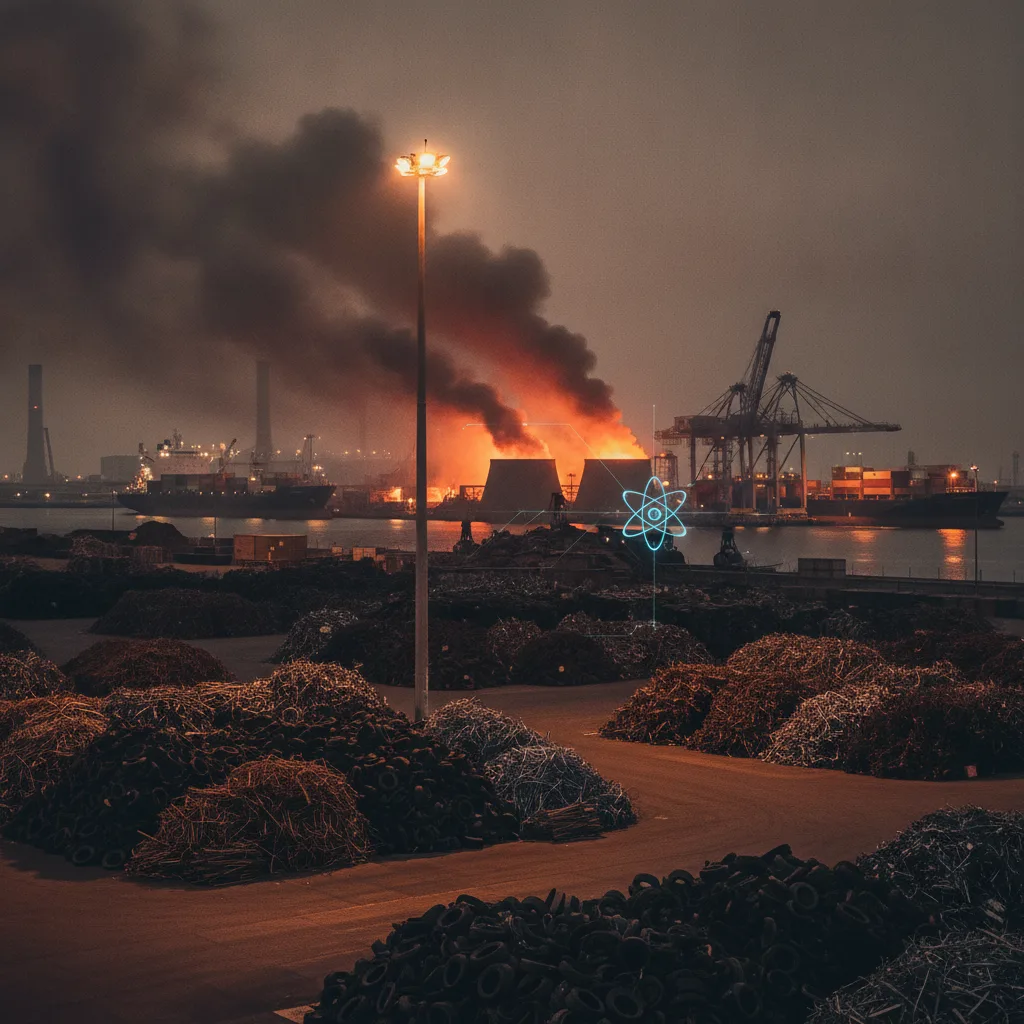
- Google signed a 22-year PPA covering up to 50% of output from Finland's Loviisa nuclear plant—its first nuclear deal outside the US—as part of a €13 billion AI infrastructure investment.
- Google's electricity demand rose 37% in 2025, yet the company achieved a 2% reduction in Scope 1 and 2 emissions, crediting its clean energy purchase programme.
- Google acknowledged its 24/7 carbon-free energy ambition is becoming harder to achieve as AI infrastructure buildout accelerates faster than grids are decarbonising.
- GCC manufacturers structuring green supply chain claims on intermittent solar alone face the same credibility gap Google is now closing with firm nuclear baseload.
A US tech company just committed €13 billion to Finland — and the most consequential line in the announcement is not the data centre count, but a 22-year nuclear power contract. Google signed a power purchase agreement with Finnish utility Fortum to buy up to 50% of the electricity output from the Loviisa nuclear plant, its largest single investment in Europe and the company's first nuclear deal outside the United States.1 For Gulf manufacturers tracking the evolution of green supply chain standards, this matters more than any solar ribbon-cutting this year.
What Google actually signed — and why it goes beyond one power deal
The Finland package is broad: three new data centres, expansion of an existing facility, grid improvements, battery projects, and onshore wind agreements.3 But the nuclear PPA is structurally different from every other line item. At 22 years, it is a generational commitment — longer than most industrial financing cycles — and it locks in dispatchable, low-carbon baseload at a fixed commercial relationship.4
Google's Chief Investment Officer Ruth Porat described the nuclear agreement as "a really important cornerstone to everything that we are doing here."4 That language is deliberate. Renewables — wind and solar — feature in the same announcement, but they are positioned as supplements, not the foundation.
This is not a standalone move. Google had already contracted with Kairos Power and the Tennessee Valley Authority for advanced nuclear capacity in the US, with up to 500 MW of small modular reactor capacity targeted by 2035.5 The Finland deal extends that logic internationally: baseload first, intermittent sources layered on top.
Why 'renewable-only' is breaking down under industrial load
Google's own environmental reporting makes the tension explicit. The company's electricity demand rose 37% in 2025 — its largest ever annual increase — yet it achieved a 2% reduction in Scope 1 and 2 greenhouse gas emissions, crediting its clean energy purchase programme.3 That is an impressive short-term result. But the same report acknowledged that Google's "moonshot" 24/7 carbon-free energy ambition is becoming harder to achieve as AI infrastructure buildout accelerates faster than grids are decarbonising.3
That admission is worth reading twice. Google has more capital, more procurement leverage, and more dedicated sustainability staff than almost any other buyer on earth — and it is still finding renewable-only arithmetic insufficient to match firm industrial load. Value chain emissions increased significantly over the same period.3
The physics are not mysterious: solar generates power during daylight hours; wind is correlated to weather systems. Heavy industrial processes — smelting, chemicals, data processing, continuous manufacturing — run 24 hours a day. Filling that gap with grid electricity from fossil sources, then purchasing renewable energy certificates to offset it on paper, is the accounting convention that more demanding frameworks are now beginning to challenge. The EU's IFRS S1 and S2 standards pushing GCC-listed companies toward granular energy disclosure make this gap increasingly visible on balance sheets.
What this means for Scope 2 reporting in manufacturing
Under market-based Scope 2 accounting, a company's reported emissions are shaped by the energy attribute certificates it holds — not necessarily by the electrons it physically consumes. This creates room for creative procurement. But as reporting standards tighten and buyers start applying supply chain sustainability pressure more rigorously, hour-matched clean energy becomes the credible standard rather than the optional upgrade.
Google's nuclear PPA is structured to deliver exactly that: a long-term, attributable, time-correlated supply of low-carbon electricity.3 When a Tier 1 manufacturer's procurement team asks its Gulf supplier to demonstrate verified Scope 2 performance, annual renewable energy certificate bundles look less convincing beside a counterparty whose baseload is nuclear-backed.
This creates a competitive dynamic. Manufacturers who move early to secure firm, low-carbon power — through PPAs, co-investment in energy projects, or government schemes — can make verifiable claims. Those who rely on grid averages and certificate purchases face growing audit risk as standards evolve. The AI-driven energy accountability pressure already reshaping data centre operations is beginning to reach industrial supply chains by the same route.
The Gulf angle: firm power, green supply chains, and competitive pressure
The GCC has extraordinary solar resources and expanding renewable capacity. That is real and material. But the region also hosts energy-intensive industries — aluminium, steel, chemicals, cement, plastics recycling — that require firm power around the clock. The question for regional operators is not whether to include renewables, but whether renewables alone can anchor a credible decarbonisation claim for buyers in Europe and North America applying supply chain due diligence.
The answer, increasingly, is no — at least not without firm baseload alongside them. Several GCC states are actively examining nuclear options; the UAE's Barakah plant is the region's most advanced example. But for the majority of Gulf industrial operators, the practical near-term question is how to structure procurement and reporting honestly given the current grid reality.
GCC manufacturers feeding into the region's $20.7 billion infrastructure wave face this directly: project developers and international financiers are applying Scope 2 scrutiny to their supply chains, and "we buy renewable certificates" is a diminishing answer. The more defensible posture is a documented energy procurement strategy that acknowledges what the grid actually delivers, plans for firm baseload where it exists, and sets a credible trajectory — not a static claim built on certificate purchases.
There is also a cost dimension. Long-term PPAs — nuclear or otherwise — provide price certainty. For capital-intensive manufacturing operations where energy represents 20–40% of operating cost, locking in a 22-year baseload price is as much a treasury decision as a sustainability one. Google's Finland move makes that case commercially, not just ethically.
Tarsyn Group's view: industrial operators need honest energy accounting, not optics
The Google deal is significant not because nuclear is new, but because it signals that sophisticated buyers are no longer willing to treat energy procurement as a reputational exercise. They are treating it as an engineering and accounting problem — and solving it with long-term, dispatchable contracts that survive audit scrutiny.
Gulf industrial operators should read this as an acceleration signal. The window for certificate-based Scope 2 claims as a credible supply chain answer is narrowing. What replaces it is not necessarily expensive: it is an honest, documented energy strategy that matches procurement structure to actual operating load — and communicates that to buyers and lenders in terms they can verify.
This means mapping current energy sources by hour, not by annual average. It means identifying where firm baseload is accessible — whether through national grid agreements, co-investment structures, or future nuclear capacity. And it means building the data infrastructure to report against that map with the granularity that IFRS S2 and similar frameworks will require.
Decarbonisation built on intermittency alone is not a strategy — it is a deferral. The Gulf's industrial base has both the geography and the policy environment to build something more durable. The question is whether operators act on that before their export customers start asking for proof.
Talk to Tarsyn Group about structuring your energy and sustainability operations for the procurement and reporting environment that is already arriving — not the one that existed three years ago. The same shift reshaping how AI companies account for their power bills is coming for every major industrial supply chain in the Gulf.
- Google will buy half the electricity of a nuclear power plant — hn:frontpage
- Google Backs its Biggest-Ever Investment in Europe with Series of Clean Energy Deals - ESG Today — www.esgtoday.com
- Google to invest US$15 billion in AI infrastructure and buy nuclear power in Finland | Awani International — international.astroawani.com
- Google Signs Deal to Power Data Centers from Advanced Nuclear Plant by 2030 - ESG Today — www.esgtoday.com